White Star Line
Location: Liverpool
Founded: 1845
Founders: John Pilkington, Henry Wilson, Thomas Henry Ismay
Successor: Cunard-White Star Line
Areas: Transatlantic, Australia and New Zealand
Note from the author: I used AI to help me re-phrase certain portions from passive voice to active voice and also to summarize sources.

Henry Cater, photographed in 1911 while working
as Third officer aboard the Olympic.
Henry Osborne Cater, the original Third Officer of the RMS Olympic, was born July 24, 1878, in the Deptford area of southeast London. His parents, Henry Brink Cater (a sailor) and Eliza Burrells, had three children, with Henry as the middle child between his older sister Eliza (born 1873) and his younger brother Sidney (born 1880). The 1881 United Kingdom census records his family living with his maternal grandmother, Eliza Burrells (née Osborne), and three maternal uncles in the London district of Westminster, while his father worked at sea. His grandmother died in 1885, and by 1891, his immediate family and two of his three maternal uncles occupied 23 South Lambeth Road in London.
Cater first went to sea in 1892 with George Windram & Sons of Liverpool. He worked his way up from Apprentice to Second Mate over 9 years and 5 months. He then joined the Donaldson Line and served as Third Mate for 2 and a half years. The 1901 United Kingdom census shows him absent at sea, with his mother, siblings, and one uncle living at 36 High Street in Leigh-on-Sea, Essex, after his father's death that year. On May 5, 1904, Cater joined the White Star Line as Fourth Officer of the SS Runic in the Australian service, holding a Master's Certificate.
Cater remained Fourth Officer of the Runic for thirteen months before joining the SS Cymric and SS Romanic in the Liverpool-Boston service in the same position. By August 1907, he obtained his first Third Officer posting aboard the SS Tropic in the Australian service. After five months, he joined the RMS Teutonic in February 1908, around the time he married Alice Mary Cooper (born c. 1869). The couple's first daughter, Mary Eleanor, was born on April 8, 1909, during his nearly two-year tenure on the Teutonic. He transferred to the RMS Oceanic in January 1910 and remained until May 9, 1911, when he joined the RMS Olympic, the largest liner in the world.
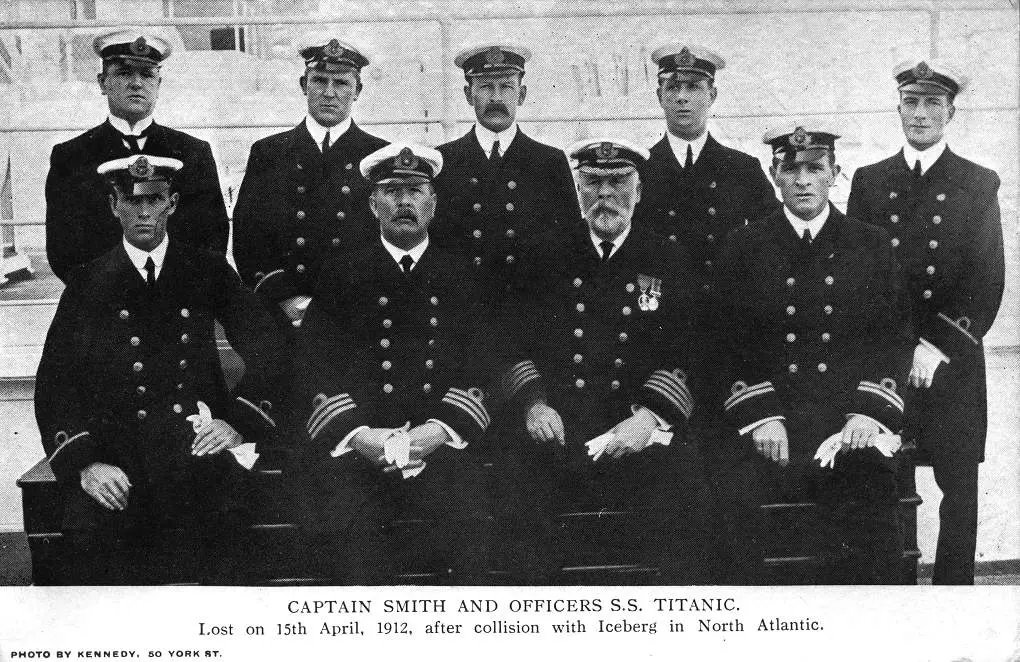
Olympic's officers. Standing: Standing: Purser Hugh McElroy
3rd Officer Henry O. Cater, 2nd Officer Robert Hume,
4th Officer David W. Alexander, 6th Officer Harold Holehouse.
Seated: 5th Officer Alphonse Martin Tulloch, Chief Officer Joseph Evans,
Captain Edward John Smith, and 1st Officer William McMaster Murdoch.
(Click image to enlarge)
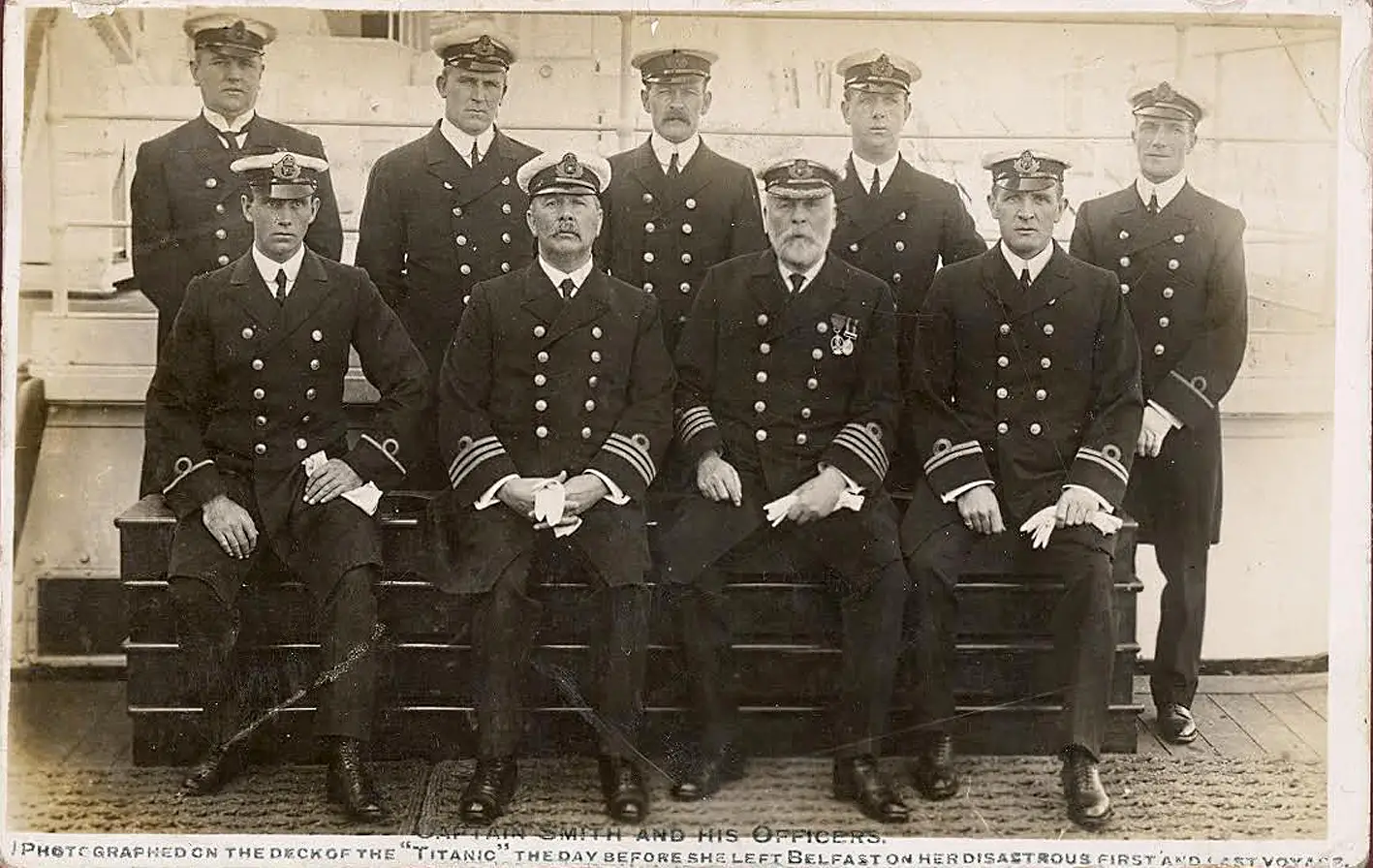
Olympic's officers (slightly different shot from above). Standing: Purser McElroy, Cater, Hume, Alexander, Holehouse. Seated: Tulloch, Evans, Captain Smith, Murdoch.
(Click image to enlarge)
The famous "Nine-Officer Photo" shows the deck officers of the Olympic posing in Belfast, with Cater standing second from the left. People frequently misidentify this photo as being one of the RMS Titanic officers, which leads them to mistakenly identify Cater as Titanic's Second Officer Charles Herbert Lightoller. Unlike other Olympic officers who receive mislabeling in casual contexts, this error has infiltrated published books. Lightoller's great-nephew, Valentine Palmer, published "Titanic and the Strange Case of Great Uncle Bertie" with a cover image of Cater. Palmer claimed his publisher made this major error, though the book remains controversial for multiple reasons.
Cater's first months on the Olympic proceeded without incident until September 20, 1911, when the Olympic collided with HMS Hawke. The collision caused severe hull damage in what became known as the "Hawke Incident." Positioned by the standard compass at the time, Cater witnessed the impact that forced the Olympic into dry dock for repairs, which in turn delayed the maiden voyage of Titanic. The Admiralty launched an investigation, and newspaper reports document testimony from most officers; however, Cater does not appear in those reports. On October 7, 1911, he transferred to the SS Corinthic in the company’s New Zealand service, placing him halfway around the world when the inquiry occurred.

Henry Cater, photographed
in 1911 aboard the Olympic.
Cater's transfer to the Corinthic brought a promotion to Second Officer, elevating him to the company's senior officer ranks. He remained on the Corinthic through November 28, 1912, which included April 15, 1912, when the Titanic sank in the North Atlantic after striking an iceberg. When the Corinthic arrived in port in Wellington, New Zealand the following day (April 16, 1912), several newspapers seized the opportunity to interview Cater. As the only man in port with intimate knowledge of the Titanic's sister ship and its safety systems, Cater offered detailed technical explanations for the disaster while also sharing his impressions of Captain Smith's careful command.
Cater correctly explained the watertight bulkhead system that both ships shared, stating that "the system of watertight bulkheads and doors was perfect in both ships" with doors that "worked automatically" with rising water activating floats connected to dynamos, and additional manual control "from the bridge" where "the captain or officers on watch, by moving this lever, can close all the bulkhead doors in an instant." He accurately predicted the sequence of the collision, declaring "In my opinion, the Titanic struck bow on, and after the fore peak was filled, the No. 1 bulkhead gave way owing to a defect caused by the impact, and then the pressure became so great that the water carried everything before it. When this happened there was no chance of saving the vessel, and down she went." His estimate that "about seven to nine knots" constituted slow speed and his calculation that "two hours" of floating time meant "there would be ample time to man the boats, get them clear of the ship, and save the passengers" proved sound. He also correctly noted that both ships carried "28 lifeboats and four collapsible boats" with capacities of "100 persons at a pinch in fair weather" for the larger boats and "about 70 or 80 souls" for the collapsibles.
However, Cater's speculation about the lifeboats diverged from reality. When asked why "the lifeboats on one side of the Titanic only were able to be launched," he replied "That I cannot say" but theorized that "the falling ice smashed some of them in and made them useless." In fact, lifeboats launched from both sides of the Titanic, though the starboard boats were launched first and with greater efficiency. Cater expressed confidence that the specially constructed davits possessed "a tremendous reach over the water" and that "no matter what list the vessel had the boats should have swung clear," suggesting he underestimated the chaos and confusion that actually prevented proper evacuation procedures. Yet he also speculated that "something happened which has prevented this being done," acknowledging the mystery without fully grasping the breakdown in command and protocol.
Despite these gaps in his understanding, Cater's respect for Captain Smith emerged clearly. He described Smith as "one of the best" and "a careful commander" who "was most particular about boat drill," recounting how Smith had once ordered the Olympic to reduce speed in fog, saying "although it was most disappointing, the safety of the passengers and ship was the first consideration." Cater concluded by defending Smith's reputation: "No, I don't think for one moment that the Titanic was out to break records on this trip. There was too much at stake."

Cater's White Star Line service record.)
When Cater left the Corinthic on November 28, 1912, he returned to the company's Atlantic service as Second Officer on the Teutonic and later the Megantic, until April 21, 1913, when he transferred back to the Corinthic. The company promoted him to First Officer at that time. Seventeen months after that, the company bumped him up to Chief Officer, and he remained in that role throughout World War I until December 1918. During this period, his wife welcomed a second daughter, Jean Elizabeth, on June 22, 1916.
Shortly after the start of the Great War, the Corinthic, under the command of Captain Frank Hart, took a number of Army Reservists belonging to the New Zealand Expeditionary Force from New Zealand to England. In 1917, she carried the 18th and half the 23rd reinforcements to England. The Corinthic travelled via the Panama Canal and was escorted from Newport News, Virginia, United States to Halifax, Nova Scotia, Canada by an American cruiser. When she left with the 23rd reinforcements in April 1917, the Corinthic steamed from Wellington via Cape Horn to Capetown. German raiders, Seeadler and Wolf, attacked at large, and the Corinthic made this unusual route to avoid them. From Capetown, the Corinthic steamed in a convoy of ten ships escorted by the armed liner Mantua to Plymouth via Sierra Leone, the whole passage from New Zealand lasting nearly three months. Sadly, many of the 23rd reinforcements became casualties in France shortly after disembarking the Corinthic.
Although he did not serve in the Royal Navy Reserve (RNR), because Cater sailed on the Corinthic while the ship engaged in troop transport during the war, the Mercantile Marine authorities awarded him a Mercantile Marine Ribbon for his role in support of the war effort. Additionally, the Dominion soldiers who travelled in that ship apparently found him "very popular."
After World War I ended and over five years on the Corinthic, Cater transferred in January 1919 to the SS Zealandic in the company's New Zealand service for one year. He then served on two Dominion Line ships with Canadian routes: the SS Canada and the SS Dominion. In November 1921, Cater returned to the White Star side of the International Mercantile Marine Co. but remained in Canadian passenger service aboard the SS Megantic, where he served until April 1924. He then transferred to the company's Liverpool-Boston service and served on all four of the company's "Big Four" ships (the RMS Cedric, RMS Celtic, RMS Baltic, and RMS Adriatic) between April 1924 and September 1927, frequently alternating between Chief Officer and First Officer positions.

Cater's White Star Line service record.)
In September 1927, Cater returned to the Corinthic for the first time in eight years, serving as Chief Officer until the end of January 1928. He then transferred to the SS Albertic in the company’s Canadian service as Chief Officer; the ship had recently been transferred to the White Star Line from the Royal Mail Steam Packet Company with its former name being the SS Ohio. After only two months on the Albertic, Cater transferred back to the RMS Baltic as First Officer in April 1928. Two months later, on June 13, 1928, he joined the SS Megantic as Chief Officer for the first time in nearly five years.
Sadly, this voyage would prove to be Cater's last. He had experienced "indifferent health" for the prior two years, and during the passage, he was "taken very ill." The ship's doctor did "everything possible" for him, but when the Megantic arrived in port on June 24, 1928, he was taken to the Montreal General Hospital. He died there six days later, on June 30, 1928, less than a month before his 50th birthday, leaving behind his wife and two daughters in Liverpool.
His funeral was held at the Sailors' Institute on July 3, 1928, with Reverend Thomas B. Jeakins officiating. Many mourners attended, including officers from the fellow White Star liner SS Laurentic then in port: Captain Edgar L. Trant, First Officer George P. Walters, Third Officer Edward A. Crowley, Fourth Officer John W. Peters, Fifth Officer Henry R. Wilkinson, and the ship's electrician. Even crews from White Star's rival Cunard attended as a show of solidarity, such as many deck crew members from the RMS Ascania, which was also in port. Marine superintendents, pilots, freight managers, and engineers from the port also paid their respects.
After the service, his body was interred at the Sailor's Plot of Mount Royal Cemetery. Interestingly, he is not the only one of the original Olympic deck officers who is buried in that cemetery, as Harold Holehouse, the original Sixth Officer of Olympic, was buried there after dying suddenly in 1937 while serving as Senior First Officer of the RMS Ausonia. Cater’s wife Alice survived another 28 years, dying in 1956 at the age of 87. Neither of their daughters ever married with the younger one, Jean Elizabeth, dying in 1971 at the age of 55 and the elder one, Mary Eleanor dying in 1994, at the age of 85.
- Family tree via (FamilySearch.org).
- 1881 United Kingdom census (via FindMyPast.co.uk).
- 1891 United Kingdom census (via FindMyPast.co.uk).
- 1901 United Kingdom census (via FindMyPast.co.uk).
- White Star Line record of company service (via FindMyPast.co.uk).
- “Collision at Spithead”, U.S. Naval Institute August 2007 (via https://www.usni.org/magazines/naval-history-magazine/2007/august/collision-spithea).
- Second Officer C.H. Lightoller- Family Legacy (via https://www.titanicofficers.com/titanic_04_lightoller_16.html).
- Manawatu Standard, April 16, 1912 (via https://paperspast.natlib.govt.nz/).
- Manawatu Times, April 20, 1912 (via https://paperspast.natlib.govt.nz/).
- Nelson Evening Mail, April 20, 1912 (via https://paperspast.natlib.govt.nz/).
- Auckland Sun, June 13, 1927 (via https://paperspast.natlib.govt.nz/).
- The Dominion, June 28, 1927 (via https://paperspast.natlib.govt.nz/).
- Montreal Gazette, July 3, 1928 (via newspapers.org).
- Montreal Star, July 3, 1928 (via newspapers.org).
- Montreal Gazette, July 4, 1928 (via newspapers.org).
- Montreal Star, July 4, 1928 (via newspapers.org).
- The Dominion, October 17, 1928 (via https://paperspast.natlib.govt.nz/).
If this website has been of some help, please consider supporting it with a coffee
to ensure it can continue. It can be anonymous. Anything helps!: