White Star Line
Location: Liverpool
Founded: 1845
Founders: John Pilkington, Henry Wilson, Thomas Henry Ismay
Successor: Cunard-White Star Line
Areas: Transatlantic, Australia and New Zealand
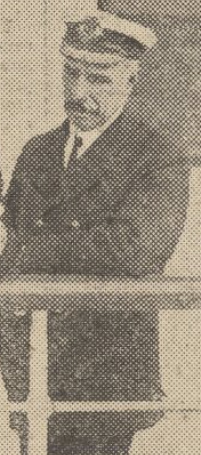
Captain Henry "Harry" Smith
(Daily Mirror, 29-August-1910).
When people say “Captain Smith”, it is Captain Edward John Smith, master of the Titanic, who went down with the ship on its ill fated maiden voyage, that comes to mind. However, he was not the only notable captain of the White Star Line with that surname. One of the others, Captain Henry “Harry” Smith (Lieutenant, R.N.R.) was born 11-June-1857 in Aldershot, Hampshire, England. His father, Robert Alexander Smith, was a soldier in the British Army. His older brother, Captain William Marchant Smith (seven years his senior), was also a Master Mariner with the White Star Line; he held sea commands primarily in the company’s Pacific service before being appointed as Marine Superintendent in New York, of which he was primarily known for. William joined the company’s service in 1878 while Henry followed in 1883.
It is not known exactly how old Henry Smith was when he first went to sea, following in the footsteps of his brother. But it is known that before joining the White Star Line, he served for two years as Second Mate with ships belonging to a firm called “G.H. Herbert”, nine months in the same role with a firm called “W. Pearce” and ten months as a First Mate with the notable Liverpool firm “Balfour, Williamson & Co.” He joined the White Star Line on 23-April-1883 as a Fourth Officer in the company’s New York service. Neither his White Star Line nor Royal Navy Reserve records list which ships he served on during his early days with the company but he was a Third Officer within three months, a Second Officer by 10-July-1895, and a First Officer by 1-January-1889, on the old Adriatic. That same year, he married the former Lizzie Josephine Fearon Clark (called Josephine) and during their marriage, they had four children: Doris, Harry, Josephine, and Eileen.
After the Adriatic, Henry Smith transferred to the Germanic as First Officer on 11-Mar-1890, and was promoted to Chief Officer after two months. He then transferred to the original Majestic in that same role in July 1891, a role which he held until 30-June-1893, when he was promoted to command that ship, his first command in the company service. His next command, the SS Cufic was a livestock carrier unlike the Majestic, which was a passenger liner. He commanded the Cufic until July 1895, when he took command, albeit for only one month, of the SS Britannic, another passenger liner and the first White Star Line ship to bear that name.
Following his stint commanding the Britannic, he commanded another livestock carrier, the SS Georgic, until January 1896 when he took command of the SS Doric in the company’s Pacific service, a role which he would hold through the turn of the century. Like many commanders in the company’s Pacific service, Smith lived in the United States during this stint, specifically in San Francisco, California, according to his RNR records, and at least two of his children were born there. He commanded the Doric for over a decade (including during the great San Francisco earthquake of 1906) until January 1907, when he transferred back to the company’s Atlantic service in command of the SS Cymric.
He only commanded the Cymric for three months before taking command of the RMS Teutonic, sister ship of the old Majestic that he had previously commanded. Between then and June 1909, he alternated between commanding the Teutonic and the SS Arabic. However, at least one event of note occurred during Smith’s command of the Teutonic, as on 28-August-1908, when the ship made contact with a whale. According to newspaper reports, when the Teutonic was one day out from Queenstown, Ireland, “she ran down a big whale, and strewed portions of its body in her wake. The starboard engines were stopped for fear the big carcase might become entangled in the blades of the ship’s propeller and cause damage beyond repair.” Captain Smith told newspaper reporters that in his years at sea, he had “never seen a whale that seemed persistently bent on self destruction”, recalling that “we sighted the whale about half a mile off our starboard bow, and as it was heading directly across our course I ordered to be starboarded to swing the vessel away from him.” The whale, which "appeared to be about fifty feet in length”, was struck “squarely” and as a result, “the starboard bow of the Teutonic was splashed high with blood.” This incident was witnessed by nearly four hundred cabin passengers.
In June 1910, Smith left the Teutonic for the SS Megantic. He had command of the Megantic till 31-December-1910, when he took command of the SS Arabic, a role he would remain in until 7-April-1910, when he transferred back to the Megantic. In his second stint commanding the Megantic, an incident involving the ship that made international headlines occurred, the “Crippen Incident.” Dr. Hawley Harvey Crippen, an American born physician who had been living in London, was suspected of murdering his wife. British authorities obtained warrants for his arrest on 16-July-1910 but as Dr. Crippen had a hunch that the authorities were on to him, he along with his mistress fled for Montreal, Quebec, Canada on board the Canadian Pacific liner SS Montrose. His luck would soon run out, as the Captain of the Montrose, Henry George Kendall, recognised Dr. Crippen and his mistress, and had his wireless operator alert British authorities just before the ship travelled beyond the range to do so.
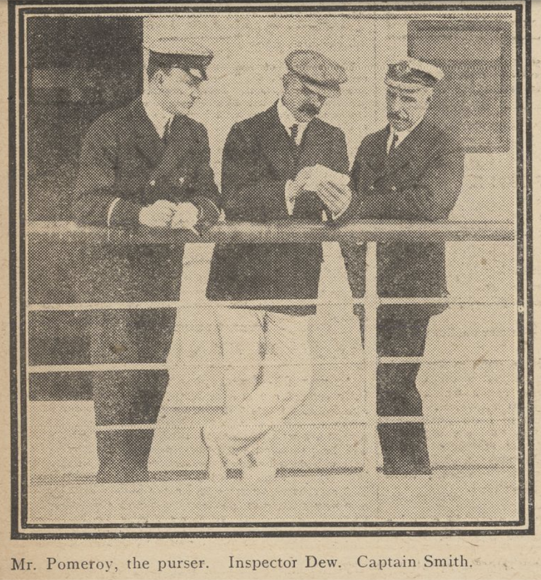
Captain Harry Smith was photographed by the Daily Mirror on 29-August-1910, looking down from the ship’s bridge with the ship’s purser and Inspector Dew standing to the left of him.
Upon receiving the news, Scotland Yard Inspector Walter Dew boarded the White Star liner SS Laurentic, under the command of Captain Bertram Fox Hayes, and as the Laurentic was faster than the Montrose, he arrived in Montreal ahead of Dr. Crippen and his mistress, and arrested the pair once the ship arrived. Once additional British law enforcement personnel arrived via other ships, Inspector Dew and the other personnel took Dr. Crippen and his mistress back to England via Laurentic's sister ship, the SS Megantic, which was under the command of Captain Henry Smith. While Captain Smith was only an ancillary character in this saga, it is notable because it produced the only known newspaper photograph of him, as he was photographed by the Daily Mirror on 29-August-1910, looking down from the ship’s bridge with the ship’s purser and Inspector Dew standing to the left of him. Dr. Crippen was later convicted of the murder and executed.
It should be noted that Henry Smith bore a facial resemblance to his brother, Captain William Marchant Smith, who is pictured below standing to the right of future Titanic Captain Edward John Smith, no relation.
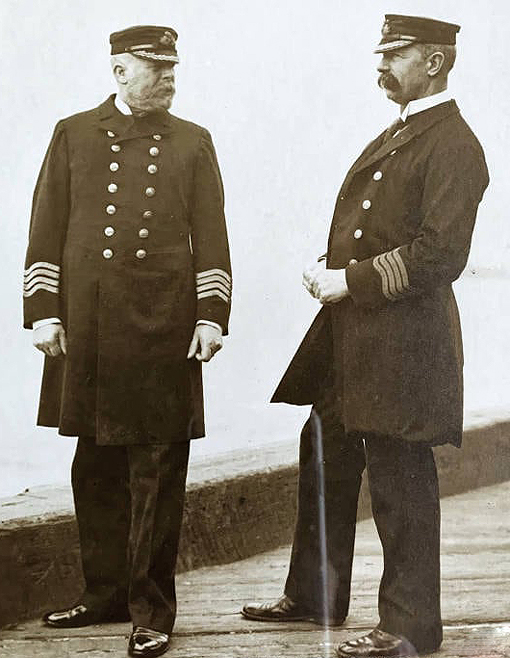
Captain William Marchant Smith, who is pictured standing to the right of future Titanic Captain Edward John Smith, no relation. (Encyclopedia Titanica).
Three months after the Crippen incident, Captain Henry Smith was transferred to the command of one of the White Star Line’s “big four”, the RMS Cedric, a role he held for only two months before returning to the Megantic from February till December of 1911. During that period, on 6-June-1911, just before the launch of the RMS Olympic, the world’s largest liner up to that point, an article appeared in the New York Times, incorrectly reporting that Captain Edward John Smith, then serving as Olympic’s commander, was planning to retire at the end of the calendar year, with his place to be taken by Captain Herbert John Haddock, then in command of the RMS Oceanic. The article also claimed that “the second big liner (in the Olympic class), Titanic, is set to enter the New York-Southampton service toward the end of the year, will be commanded, it is said, either by Captain Bertram Fox Hayes or Captain Henry Smith.” That reporting of course turned out to be false, as Captain Edward John Smith did not retire and took command of Titanic and went down with it on its ill-fated maiden voyage, which was delayed to April 1912.
This speculative article is not the only possible link between the Titanic and Captain Henry Smith. Titanic Captain Edward John Smith was known as the “Millionaire’s Captain” and some passengers chose to book their travels specifically on ships that the former commanded. Content creator @historywithcara claims that Titanic passengers John Pillsbury Snyder and Nelle Snyder, who were returning to the United States from their European honeymoon, were horrified when they found out that a “Captain Smith” was to be in command of Titanic, as when they had left the United States for their three month European honeymoon, they left on a ship also commanded by a “Captain Smith”.
Furthermore @historywithcara also added that the “Captain Smith” who commanded that ship gave orders to sail full steam ahead while the ship was still tied to the pier and according to Nelle, “they nearly took the entire structure with them.” And on that same voyage, the ship ran onto a sandbar in Gibraltar, and they had to wait for the tide to change because they were stuck. And when they arrived in Naples, Italy, they were relieved to get off the ship. They had originally booked passage on board another ship, but due to a coal strike, they were transferred to Titanic. When Nelle found out that Captain Edward John Smith was to be in command, she was horrified, but it turned out he was not the same “Captain Smith” who had commanded the ship they travelled to Europe on. While it is not certain if Captain Henry Smith was the “Captain Smith” who commanded that ship, it is possible, as the ship he was known to be in command of at the time, the RMS Cedric, was operating on winter cruises during that time according to a booklet belonging to Andrew Kroll, a friend of Titanic historian Gavin Krom. It is also possible, albeit unlikely, that the other “Captain Smith” was the Cunard Line’s Captain Charles Appleton Smith, who held command of the RMS Franconia at the time, which also serviced the Mediterranean during the winter.
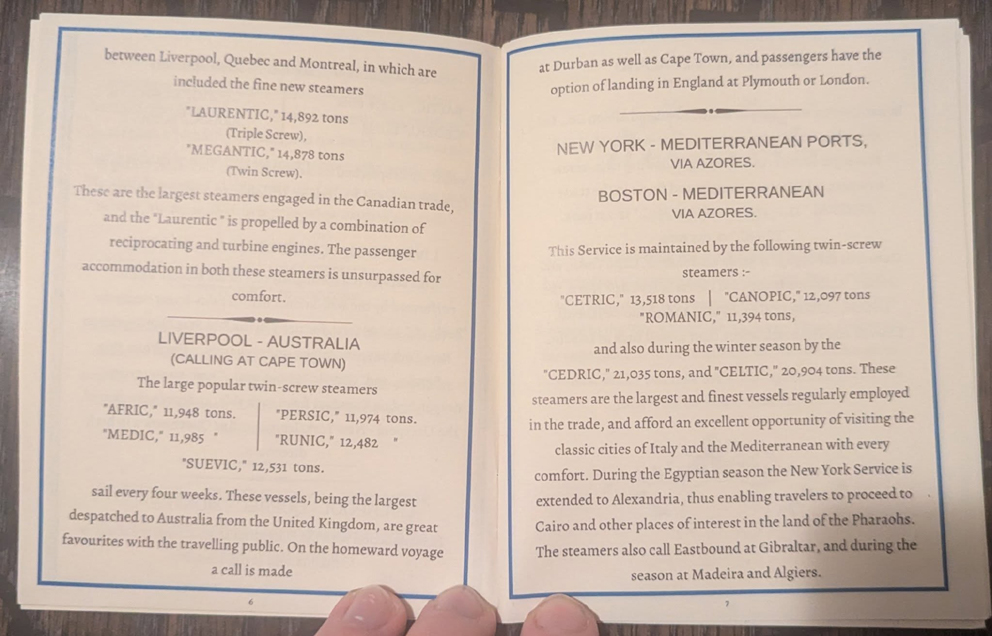
The RMS Cedric, was operating on winter cruises according to a booklet belonging to Andrew Kroll. (Click to enlarge)
According to his White Star Line records, Henry Smith held command of the Cedric until 30-April-1912. Therefore, it is probable that he was commanding it when White Star Line Managing Director J. Bruce Ismay, who survived the Titanic, had tried, via wireless, to have the company’s New York office hold the Cedric in port a little longer so that he and surviving crew members of the Titanic could immediately return to England after disembarking the Titanic’s rescue ship, the Cunard liner RMS Carpathia. In the end, that message was intercepted by American authorities and he along with others were immediately summoned to testify at the American inquiry into the disaster. It is not, however, 100% certain if Henry Smith was commanding the Cedric during this time, as the records of fellow White Star Line Captain James Oliver Carter show that he took command of the Cedric in “March 1912.” But it is likely, as Captain Carter’s RNR records show that he took command of Cedric on 29-April-1912, which lines up with the fact that on 30-April-1912, Captain Henry Smith took command of the RMS Oceanic, which had been docked in Southampton during the coal strike, and whose previous commander, Captain Herbert John Haddock, transferred to the RMS Olympic in relief of Captain Edward John Smith, who of course transferred to Titanic for its ill fated maiden voyage. The below Hampshire Independent article from 11-May-1912 describes the Oceanic’s return to service.
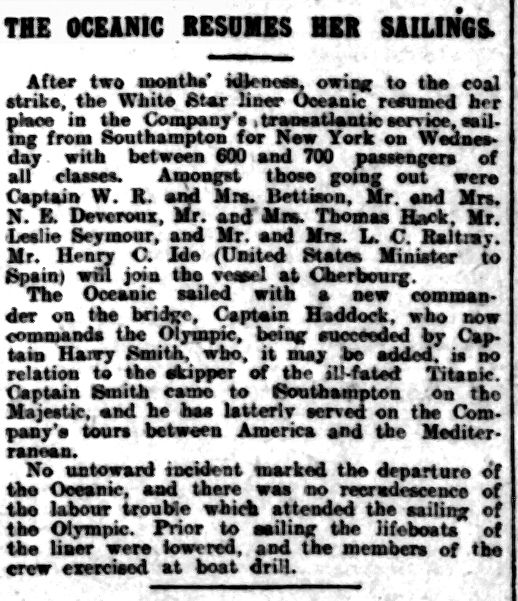
The Hampshire Independent article from 11-May-1912
describes the Oceanic’s return to service.
On 8-May-1912, not long after Captain Henry Smith took command of the Oceanic, the ship’s First Officer, Frederick August Frank, spotted one of the Titanic’s lifeboats, Collapsible A, as the ship was travelling through the Atlantic. The boat was seen floating in the ocean with three decomposing bodies, as well as a fur coat belonging to Titanic survivor R. Norris Williams, on board. Captain Smith ordered the ship to stop and it came to a rest approximately 800 yards away and he dispatched one of the Oceanic’s own lifeboats, in the charge of Fourth Officer John Withers (who had just transferred from Olympic and had been on it during Captain Edward John Smith’s final voyage in command before transferring to Titanic as well as when it received Titanic’s distress calls), to retrieve the bodies. Once the bodies were retrieved, the ship’s Surgeon, Dr. Riversdale Sampson French, identified them, and a Bo’Sun named Jones who had been a sail maker and had experience burying bodies at sea in the Red Sea, volunteered to sew them up.
Once the bodies were sewn up, “Oceanic’s flag was lowered to half mast as Dr. French read out the service and Captain Smith, his officers and crew ‘stood to attention bareheaded on the upper deck with the passengers.” Captain Smith recorded what happened afterwards in the ship’s log, “As the doctor uttered the words ‘We commit these bodies to the deep’, the sailors let the three canvas covered bodies sink beneath the waves, and the boat pulled back to the Oceanic towing the Titanic’s boat astern. By the position the boat was found in she must have drifted seven and three-quarter miles a day.” He also added that “Three bodies were found in the boat but being decomposed and unfit for removal these same were committed to the deep from the boat, service being read by Doctor French. One presumably was the body of Thomson Beattie, identified by name on pocket lining of coat, the others, a sailor and firemen respectively. A fur lined overcoat was found in the boat and letters in pocket addressed to Richard Williams, also two rings welded together as one inscription on inside of one ‘Edward & Gerta’ on the other ‘Edward’. Ship proceeded at 2.27 p.m. having taken on board collapsible boat which is marked No 1. Deck lifeboat certified by Board of Trade to carry 47 persons.”
Captain Henry Smith remained in command of the Oceanic for the remainder of its service. On 6-February-1914, while the ship was one day out from Queenstown, Ireland (just as the Teutonic was almost six years earlier when it collided with a whale), it was struck by a “rogue wave”. A New York Tribune report noted that “Captain Harry Smith, who has been in the company’s service longer than any of the company’s captains, said he had never encountered such storms as occurred on February 6, , 10, 11, and 12.” The winds from the wave caused the windows of a stateroom to be “smashed to bits”, with one of the bits hitting a passenger in the head and “inflicting a deep cut.” Also due to the impact of the wave, a party of nine passengers who were sitting in chairs on the promenade deck were “bowled over like ninepins.” Two of those passengers had to swim to the rail in order to avoid falling into the ocean. When Captain Smith finally docked the Oceanic in New York upon its arrival, it was the first time in thirty-six hours that he had left the bridge and it was also noted that he “averaged four hours’ sleep throughout the journey.” It should also be noted that the following day, the RMS Olympic was struck by a similar wave, which resulted in flying glass causing injuries to twelve people, including the ship’s purser.
Unfortunately, this would not be the most devastating incident Captain Henry Smith experienced on board the Oceanic. Upon the outbreak of World War I, the ship was mobilised for naval service as an armed merchant cruiser, and a career Royal Navy officer, Captain William Firth Slayter, was placed in command. However, Captain Henry Smith remained on board with the rank of Commander, R.N.R., so in effect, the ship had two masters, which caused some confusion as to the proper chain of command. Besides Smith, other White Star Line personnel serving aboard the ship included Charles Herbert Lightoller, the Second Officer of the Titanic and its most senior officer to survive the disaster; David Blair, who was originally going to be the Titanic’s Second Officer on that trip before a last second crew reshuffling; Charles Herbert Greame, who had been the ship’s Chief Officer in the merchant service and had also served on Olympic; and George Ernest Warner, then a master of the Shire Line’s Monmouthshire, who would later command the Olympic after the White Star Line absorbed the Royal Mail Steam Packet Company, which had itself absorbed the Shire Line a few years prior. Additionally, one of the ship’s engineers, Garfield Stephens, had been on the Titanic on its delivery trip and later served on Olympic, culminating as Assistant Chief Engineer at the time of its 1935 retirement.
On the night of 7-September-1914, while the ship was near the Shetland archipelago of Scotland, David Blair (Lieutenant, R.N.R.) made a navigation error which put the ship directly on course for a reef, the Shaalds of Foula. Captain Slayter, who was unaware of the inaccurate position, had given orders to steer towards Foula but he had retired for the night and handed over the morning watch to Henry Smith. “Having previously disagreed with his naval superior about navigating a ship as large as Oceanic in the dangerous waters around the Scottish islands, he instructed the navigator to plot a course west, and out to sea, away (so he thought) from hidden dangers like outlying reefs. Unbeknown to Smith, this put the ship onto a course between the island and the reef just south of it. Slayter must have felt the course change, as he reappeared on the bridge to countermand Smith's order and made what turned out to be a hasty and ill-informed judgement, as the ship again changed course directly towards the reef”. On the morning of 8-September-1914, the ship ran aground. All of the ship’s crew survived and were rescued by other Royal Navy cruisers, and Charles Herbert Lightoller, the ship’s First Officer (and also the most senior officer to survive Titanic) was the last person off the ship, taking the ship’s navigation room clock with him as a souvenir. Once Smith came ashore, he commented that “ the ship would stay on the reef as a monument and nothing would move it. One of the Foula men, wise to the full power and fury of a Shetland storm, is said to have muttered with a cynicism not unknown in those parts "I‘ll give her two weeks". On 29-September, three weeks after the initial incident, locals discovered that the ship had been "swallowed by the ocean.”
After the wreck of the Oceanic, Lieutenant Blair, Commander Smith, and Captain Slayter, were all court-martialed. Lieutenant Blair was found guilty of “stranding the ship by omitting to take proper precautions to sound after experiencing abnormal compass deviation and also by not suggesting immediate stoppage of the engines on unexpectedly sighting land.” Blair was ordered to be reprimanded. His defence argued that he was not responsible, as “the Captain (Slayter) and the Commander (Smith), had undertaken the direction of the ship and assumed responsibility.” Commander Smith was also acquitted, as the court found that he was not entitled to assume command from Captain Slayter, and therefore “not officially in charge or command on 8-September.” Captain Slayter was also acquitted.
The sinking of the Oceanic would mark the end of Henry Smith’s tenure in the service of the White Star Line but he continued to serve in the Royal Navy Reserve in support of the war efforts. It is not known which RNR ships he served on after the Oceanic sank, as no ships are listed in his RNR records after the Oceanic. However, it is known that he “was awarded the DSO in 1917 “in recognition of his services on vessels of the auxiliary patrol between 1st February and 31st December 1916.” And after the war ended, on 6-April-1919, he was sent by the British Ministry of Shipping to take command of the former German liner SS Ypiranga, which had belonged to the Hamburg America Line but was seized by the United Kingdom for war reparations. In command of Ypiranga, he took troops home from Australia until his permanent retirement on 31-July-1920. A year later, the Ypiranga was awarded to the Anchor Line and renamed Assyria.
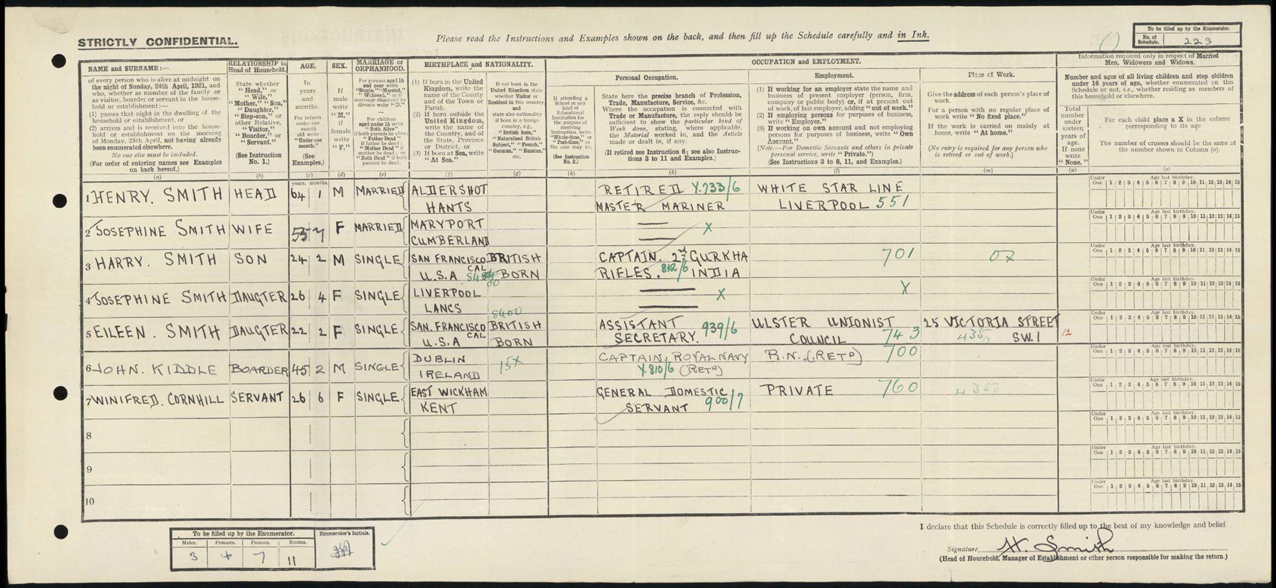
The 1921 United Kingdom census shows Henry Smith continuing to reside at 63 Collingwood Avenue in the Muswell Hill district of London. (Click to enlarge)
The 1921 United Kingdom census shows Henry Smith continuing to reside at 63 Collingwood Avenue in the Muswell Hill district of London. His occupation is recorded as “retired Master Mariner,” and the household included his wife, his son Harry, daughters Josephine and Eileen, a boarder, and a domestic servant. In retirement, Captain Smith remained connected to the wider world he had known at sea. In December 1925 he travelled first class aboard the RMS Majestic, then under the command of Captain George Robert Metcalfe, to visit his brother in the United States, who after himself retiring from the White Star Line, had settled permanently in the United States. After his brother’s death in December 1932, Henry lived only a few years longer. He died at Finchley Memorial Hospital on 12 July 1935 at the age of 78. His widow survived him, and probate records show that his estate, valued at £287, was awarded to her.
His funeral was officiated by the Rev. Eric Cordingly, who was engaged to his granddaughter Mary Mathews, the daughter of his daughter Doris. Rev. Cordingly would later serve as a British Army chaplain during the Second World War, spending time as a prisoner of war before recounting those experiences in a published memoir. He subsequently rose to become Bishop of Thetford, a position he held until his death in 1976. Through this branch of the family, Smith’s legacy extended into later generations as Rev. Cordingly’s eldest son, David Cordingly, became a distinguished naval historian, providing a notable continuation of the family's long association with the sea.
- Encyclopedia Titanica thread (Captains William and Harry Smith; https://www.encyclopedia-titanica.org/community/threads/captains-william-and-harry-smith.25537/).
- White Star Line service records (via FindMyPast.co.uk).
- Royal Navy Reserve records, ADM-240 for Henry Smith and James Oliver Carter (via nationalarchives.gov.uk).
- Wikipedia article on Hawley Harvey Crippen (https://en.wikipedia.org/wiki/Hawley_Harvey_Crippen).
- Encyclopedia Titanic thread (Dr. Crippen; https://www.encyclopedia-titanica.org/community/threads/dr-crippen.25818/).
- Titanic‘s Collapsible A: Oceanic‘s First Officer Sights the Lifeboat Adrift, May 1912 (https://markchirnside.co.uk/titanics-collapsible-a-oceanic-may-1912/).
- 1914: Liners Meet Rogue Waves (https://oceanlinersmagazine.com/2021/02/05/1914-liners-meet-rogue-waves/).
- Wikipedia article on RMS Oceanic (https://en.wikipedia.org/wiki/RMS_Oceanic) sourced from the book “Holbourn, Ian Stoughton (2001). The Isle of Foula. Birlinn Ltd. ISBN 1-84158-161-5.”.
- The Dreadnought Project article on William Firth Slayter (https://dreadnoughtproject.org/tfs/index.php/William_Firth_Slayter).
- Wikipedia article on SS Ypiranga (https://en.wikipedia.org/wiki/SS_Ypiranga).
- 1921 Census of England & Wales (via FindMyPast.co.uk).
- England & Wales Government Probate Death Index (via FindMyPast.co.uk).
- Mary Eileen (Mathews) Cordingly family tree (via https://www.wikitree.com/wiki/Mathews-7987).
- Wikipedia article on Eric Cordingly (https://en.wikipedia.org/wiki/Eric_Cordingly).
- Wikipedia article on David Cordingly (https://en.wikipedia.org/wiki/David_Cordingly).
- Dundee Evening Telegraph (28-August-1908).
- Daily Mirror (29-August-1910).
- New York Times (06-June-1911).
- Star (10-September-1914).
- London Daily News (20-November-1914).
- Derry Journal (23-November-1914).
- Social media post from @historywithcara (https://www.facebook.com/share/r/1E7MJWpDww/).
If this website has been of some help, please consider supporting it with a coffee
to ensure it can continue. It can be anonymous. Anything helps!: