White Star Line
Location: Liverpool
Founded: 1845
Founders: John Pilkington, Henry Wilson, Thomas Henry Ismay
Successor: Cunard-White Star Line
Areas: Transatlantic, Australia and New Zealand
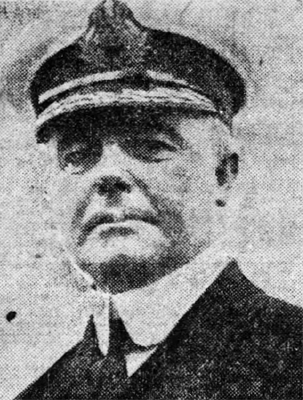
Captain Frank B. Howarth (Boston Globe
05 June 1915.)
Captain Frank Briscoe Howarth was born on 11 August 1864 in Stockport, Cheshire, England to John and Elizabeth Howarth. He was the fourth of seven children with one older sister (Anne), two older brothers (Samuel and Fred), and three younger sisters (Emma, Edith, and Ellen). His father was a grocer and tea dealer. The family resided at 33 Wellington Road, South, in Stockport and they were comfortable, as the 1871 Census of England and Wales shows a 19 year old female servant from Wales living with them. He attended a school in Lewisham, though it is not known which one. His father died in 1876 and by 1881, the rest of his family relocated to 91 Hornby Road in Layton with Warbreck (presently Blackpool), Fylde, England. The 1881 Census shows his mother’s occupation as a grocer, so it is likely she took over her late husband’s business. In 1881, Frank was the oldest of his siblings still residing at home and was listed as unemployed. That would soon change however, as within the next year, at the age of 17, he would join his first ship.
The first shipping firm Howarth joined was Messrs. Davidson and Besset, of Liverpool, as an apprentice. His first ship was the barque Balalava, trading mainly between Australia and San Francisco. He remained with that firm until 1887, when he joined the firm Edward Bates & Sons, also of Liverpool, as a Second Mate on the old China clipper Khimjod Woodowdee. On the aforementioned ship, which made voyages to the Far East, including Java and Sumatra, he had a terrible experience. As the ship arrived in Sumatra, much of the crew were stricken with fever and not long after, the master and “practically all the hands” had died, leaving Howarth, the Second Mate, as the most senior surviving crew member. Therefore, it fell to him to navigate the ship to another port where a new crew was signed on. After that ordeal, he joined yet another Liverpool firm, Gillison and Chadwick, where he served as a Second Mate on their big four-masted ships sailing to San Francisco. However, the big break in his young career would come in 1892. After obtaining his Master’s Certificate on June 18th of that year, he joined the White Star Line on August 1st, as Fourth Officer of the SS Coptic sailing to New Zealand.
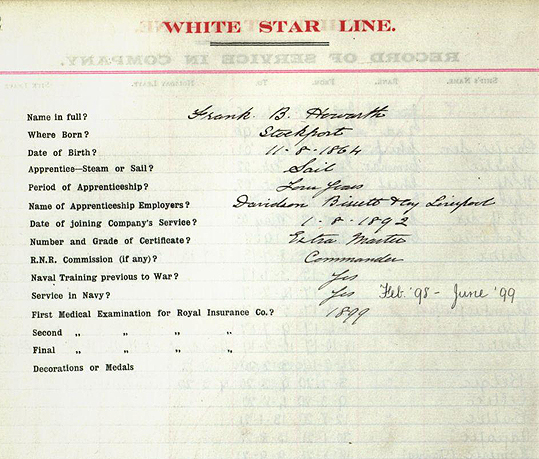
Howarth's White Star record.
It is not known exactly which ships (if any) other than the Coptic that Howarth served as a Junior Officer of in between 01 August 1892 and 26 November 1895, as his White Star Line service records do not specify and his Royal Navy Reserve records do not go back any further than the latter date. On the aforementioned date, he joined the SS Nomadic (later renamed the SS Cornishman, NOT the Nomadic that served as a tender to Olympic and Titanic) as Second Officer. During his time on the Nomadic, he married his wife, the former Clara Wade, in September 1893. On 05 January 1895, the couple’s first daughter Miriam was born. He remained in that role on the Nomadic until 10 September 1896, when he transferred to the same position on the original SS Georgic, which had entered service a year earlier as the world’s largest cargo ship. During his tenure on the Georgic, his wife gave birth to a second daughter, Madeline, on 01 October 1896. After five months on the Georgic, he transferred to the original SS Britannic (also as Second Officer) for four months, before obtaining his first posting as a First Officer, on the original SS Adriatic on 03 July 1897. One month later, he joined the RMS Teutonic as Second Officer for two months before joining the SS Germanic for one month, then the original SS Adriatic again for another month, then the Germanic again for two months, until 14 February 1898, his first naval leave.
Howarth’s first naval leave lasted sixteen months, during which he served on the HMS Scylla, a second-class cruiser, under then-Captain (later Admiral) Sir Percy Scott. Once his naval leave concluded, he sat for his Extra Master’s certificate, which he obtained on 12 June 1899. Just over a week later, he returned to the service of the White Star Line on 21 June 1899, as First Officer of the SS Cymric, a role which he held until 11 November 1900, when he became First Officer of the RMS Oceanic, then the world’s largest ship. A year later, he obtained his first Chief Officer posting with the line, on the SS Germanic, a role which he would hold for over a year. During this period, he is absent from the 1901 Census, as he was away at sea, but his wife and daughters were shown to be residing on Old Town Lane in Formby, Lancashire, England, along with a female domestic servant. In May 1903, three months after its maiden voyage, he served for one month as First Officer on the RMS Cedric, the second of the White Star Line’s “Big Four” before fleeting back up to Chief Officer on the original RMS Majestic, then under the command of future Titanic Captain Edward John Smith.
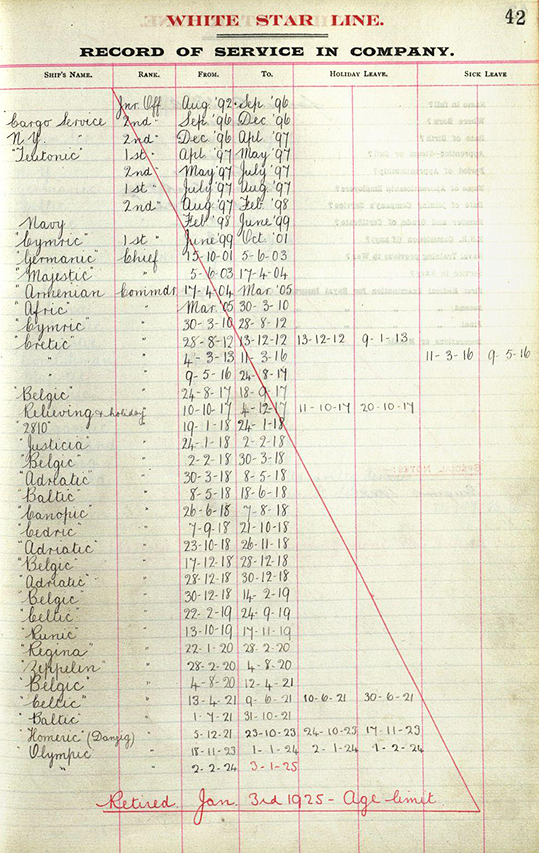
Howarth's White Star record detailing the ships he worked aboard.
After ten months as Chief Officer of the Majestic, on 17 April 1904, Howarth received his first command, the SS Armenian, a cargo liner owned by the Leyland Line but managed by the White Star Line. He commanded the Armenian for approximately a year, as on 11 April 1905, he transferred to the SS Afric in the company’s Australian service, a ship which he would command for five years, the longest time he would serve on one ship consecutively during his entire career. Despite his long tenure on the Afric, it was a rather uneventful one, as the only mishap that received any newspaper coverage occurred on 23 August 1906, when the vessel struck some obstruction as it was pulling out of the middle channel at Port Phillip Heads, but the hull was not seriously damaged. Also during his tenure on the Afric, while the ship was in port in early February 1908, Howarth was given a tour of Port Adelaide’s outer harbour by the local harbourmaster, whom he thanked for his kindness in a letter that was published in the papers.
Captain Howarth’s tenure on the Afric concluded on 30 April 1910, when he returned to the company’s Atlantic service in command of the SS Cymric, a ship which he had previously served as First Officer on. Less than two weeks into his tenure commanding the Cymric, the ship’s foremast was struck by lightning, which “smashed the ball and splintered the truck for a foot”, though the ship docked safely. The Cymric also made the news on 26 October 1911, as Boston newspapers reported that as it arrived in port, it had been “racing” with the Cunard line steamer Ivernia from Liverpool to Queenstown to Boston. While neither Captain Howarth nor Ivernia's master (Captain W.R.D. Irvine) admitted the ships were racing, supposedly some of the ships’ deck officers admitted they were, and the saga was of “great interest” to passengers of both ships.

RMS Cymric.
Captain Howarth was still in command of the Cymric in April 1912, when fellow White Star liner Titanic struck an iceberg in the North Atlantic and sank, resulting in the loss of around 1,500 souls. The Cymric had left Liverpool for Boston on the same day (10 April) that Titanic departed Southampton for New York. According to the brother of a Cymric passenger in a letter to the editor of the New York Times, the Cymric did receive Titanic’s distress calls but Captain Howarth knew they would not be able to render assistance. During the voyage, the passengers encountered “bitter cold” and fog, as the ship sailed through the ice fields of the North Atlantic. Given the tragedy that had just occurred, “Captain Howarth and his crew were very cautious, as he stayed on the bridge for at least 48 hours keeping a lookout for wreckage, but the fog was too thick for him to see any.” To avoid causing a panic, the Cymric’s passengers were not told of the Titanic disaster until the ship arrived in port and they were informed by Custom House officers. Captain Howarth was not called to testify at the British or American inquiries into the Titanic disaster and remained in command of the Cymric until 28 August 1912, when he transferred to the SS Cretic.
When Captain Howarth took command of the Cretic, it was engaged in the company’s Mediterranean service to Genoa, Italy. The first two years of his tenure on that ship were rather uneventful but that would soon change on 04 August 1914, when Britain declared war on Germany. For the first part of the war, the Cretic remained in active passenger service; though it did carry around a dozen Italian reservists from Boston back to Italy to join the war effort. On 11 February 1916, an American doctor who was returning home on the Cretic from Red Cross work in Europe claimed that when the ship was a day out from Gibraltar, he and his fellow passengers saw a vessel and that upon seeing the vessel, the Cretic altered its course until the vessel disappeared. The passengers believed the mysterious ship was the German raider SMS Möwe but Captain Howarth laughed at that claim when confronted by a reporter, claiming that if it indeed had been the Möwe, the Cretic would have never reached Boston. Captain Howarth’s tenure on the Cretic concluded on 24 August 1917, making it the ship he served on for the second longest after the Afric. For the remainder of the war, Captain Howarth remained in the company’s Mediterranean service as a relief captain. Under this arrangement, he “jumped from ship to ship”, providing other White Star Line captains a “well-earned rest.” The ships he commanded during this time were as follows: SS Belgic, RMS Olympic, SS Justicia, RMS Adriatic, RMS Baltic, SS Canopic, RMS Cedric, and RMS Celtic. On the Celtic, his Chief Officer was none other than Charles Herbert Lightoller, Titanic’s Second Officer and senior most surviving officer, and they brought the last Canadian troops home from the war.
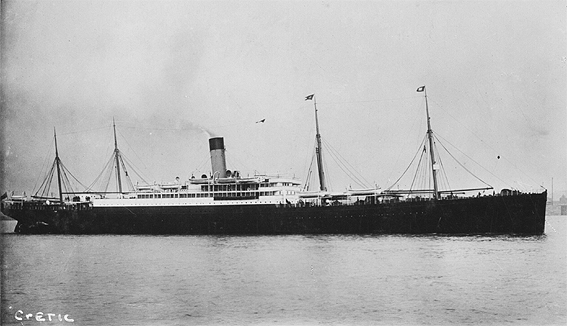
RMS Cretic.
Once the war ended, Captain Howarth briefly commanded the SS Runic and SS Regina. His service on the latter ship ended on 28 February 1920, when he took command of the USS Zeppelin. The Zeppelin was a German ship launched in 1914 for the Norddeutscher Lloyd Line. As it was not long after its launch that World War I commenced, it was laid up and soon after seized by the United States as war reparations. Once the United States Navy formally acquired the Zeppelin, the ship was delivered to the British Shipping Controller under operation of the White Star Line. While Captain Howarth only commanded her for eight months (from Liverpool to Bombay, India), it would not be the first former German liner he would command. After the Zeppelin, he again commanded the SS Belgic, RMS Celtic, and RMS Baltic before taking command of another former German liner, the RMS Homeric, on 05 December 1921.
The Homeric, launched in 1913, was originally ordered by the German Norddeutscher Lloyd Line as the Columbus but once the war began, construction halted. When World War I ended, the RMS Olympic lacked any suitable running mates on the White Star Line’s weekly Southampton-New York express service, as in addition to Titanic, its other sister ship Britannic was lost during the war after striking a mine in the Aegean Sea and the smaller RMS Oceanic, another ship that served that route, was also lost during the war. Under the Treaty of Versailles, Britain was entitled to war reparations from Germany and as a result, the White Star Line sought to obtain some unfinished German ships to give Olympic running mates as originally planned. The 56,000 ton Hamburg America liner SS Bismarck became the RMS Majestic and the Columbus became the RMS Homeric. This trio of White Star ships served as direct competition to the Cunard trio of the Mauretania, Aquitania, and Berengaria (originally the Hamburg America liner SS Imperator, also awarded as war reparations).
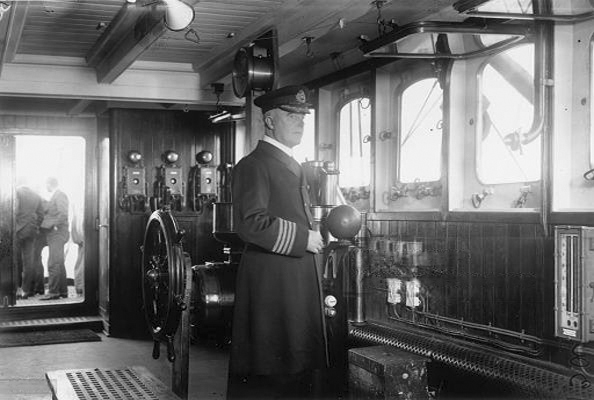
Captain Howarth on the bridge of RMS Homeric.
Captain Howarth took command of the Homeric as it was being finished in Danzig, Germany by the builder F. Schichau,and remained in command for its first transatlantic voyages. Despite being almost 10,000 gross registered tons smaller than Olympic, as well an average of three knots slower, it still became a popular ship. It was the world’s largest twin-screw ship at the time and according to Captain Howarth’s great-nephew John Anderson, it was his favorite ship to command. In late 1922, as the Homeric neared Southampton, it came within 200 yards of a mine that had been placed by the Germans years earlier during the war but Royal Navy minesweepers were able to clear it. He remained in charge of the Homeric until 23 October 1923, when he went on a brief holiday before the biggest assignment of his career. During his time in command of the Homeric, Captain Howarth’s family grew as both of his daughters got married. His elder daughter Miriam married Eric Hylton Stewart on 29 August 1922 and his younger daughter Madeline married Edward Sawers on 21 March 1923.
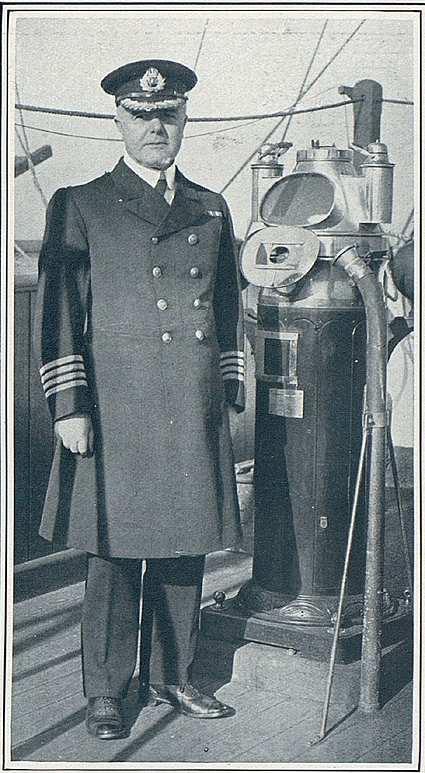
Captain Howarth aboard the RMS Homeric.
On 17 November 1923, Captain Howarth returned from his holiday leave, and the next day he assumed command of the RMS Olympic, succeeding the retiring Captain Hugh Frederick David. At that point, the Olympic was the White Star Line’s second largest vessel behind the RMS Majestic. Since the end of the war, the Olympic had not experienced any noteworthy near-collisions or incidents with other ships that attracted media coverage. That soon would change however, as on 22 March 1924, as the Olympic was reversing out of its pier into the river, its stern collided with the Fort St George. At 7,785 gross registered tons, Fort St George, owned by the Bermuda & West Indies Steamship Company, was a fraction of the size of Olympic and as such, the damage it sustained was significant (approximately 150,000). Three female passengers on the Fort St. George were slightly injured as a result of the collision and the ship’s voyage was cancelled. The Olympic was only slightly damaged and after being laid up in Quarantine for an hour to ensure its steering apparatus functioned properly, it was allowed to continue on its journey.
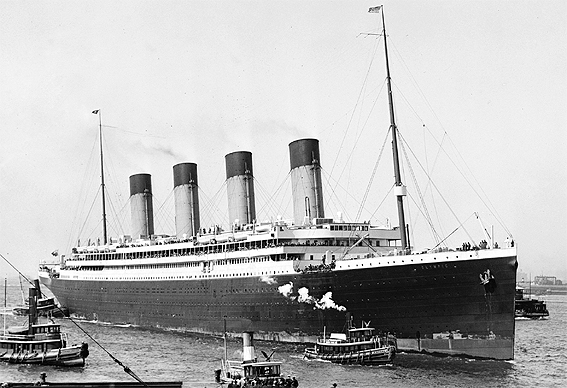
RMS Olympic arriving at New York on her maiden voyage, 21 June 1911 (George Grantham Bain collection, Library of Congress).
This would not mark the end of the saga however, as legal action ensued, with the White Star Line alleging in a libel case (filed in the Southern District of New York in the United States) that the Fort St. George “had not been in the charge of a competent person,” which the Bermuda & West Indies Steamship Company countered. Despite claims that he ceded charge of Olympic to Harbour Pilot John Swainson as the ship was backing out, Captain Howarth along with other Olympic crew members, still had to testify during the legal proceedings, which dragged on for a few years. Eventually, in July 1927, Judge Augustus Hand ruled in favor of the White Star Line, finding the Fort St. George was at fault due to its excessive speed, while also asserting that its crew should have known that Olympic would need more space to maneuver due to its massive size.
Besides the Fort St. George fiasco, other significant events occurred in both Captain Howarth’s personal life as well as in the career of the Olympic. On 16 June 1924, Captain Howarth and his wife became grandparents, with their elder daughter Miriam giving birth to a daughter. But it was 25 October 1924 when more publicity hit the Olympic. On that date, the Prince of Wales (the future King Edward VIII) boarded the ship in New York on his way home to Britain. Captain Howarth, along with Sir Esme Howard, the British Ambassador in New York, personally escorted the Prince up the gangway. And before the ship departed, the Prince, his entourage, and Captain Howarth were photographed and recorded by the press on the starboard side of Olympic’s bridge. The Prince’s trip aboard Olympic also had a Titanic connection as its last surviving crew member, Sidney Daniels, who had been a Third Class steward, returned to Olympic after the disaster and remained on it for the rest of its career. According to his daughter, he had worked his way up to First Class Steward by 1924 and was one of just a few chosen as a bedroom steward for the Prince.
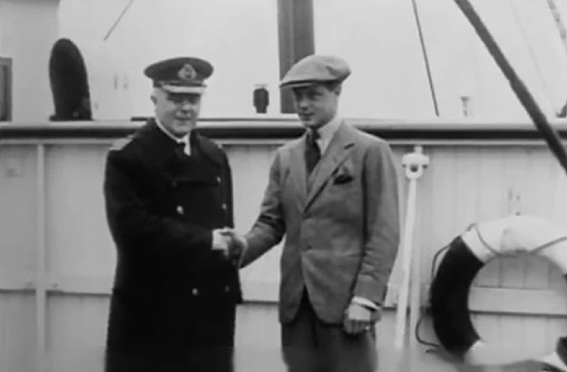
Captain Howarth with the Prince of Wales
on board RMS Olympic.
As Captain Howarth turned 60 on 08 August 1924, he hit the company’s mandatory retirement age. A few months later, on 03 January 1925, he officially retired after the Olympic arrived in Southampton. When interviewed by reporters, he stated that he had never been shipwrecked, a remarkable feat for someone who had been at sea for over four decades. Two days later, a ceremony honoring his retirement was held on board the ship. Many members of the ship’s victualling department attended and the ship’s Chief Steward, Samuel Tweedie, who had sailed with Captain Howarth since his first command on the SS Armenian, personally presented the retiring captain with retirement gifts including an inscribed card, as well as a gold-mounted walking stick. Additionally, Philip Curry, the White Star Line manager in Southampton, noted that “during the time Captain Howarth had been in command of White Star ships, he had always given the most perfect satisfaction, and the discipline on his ships had always been excellent.” After Captain Howarth himself spoke, thanking everyone for their kindness, his retirement celebration concluded with the singing of “For he’s a jolly good fellow,” and three ringing cheers.
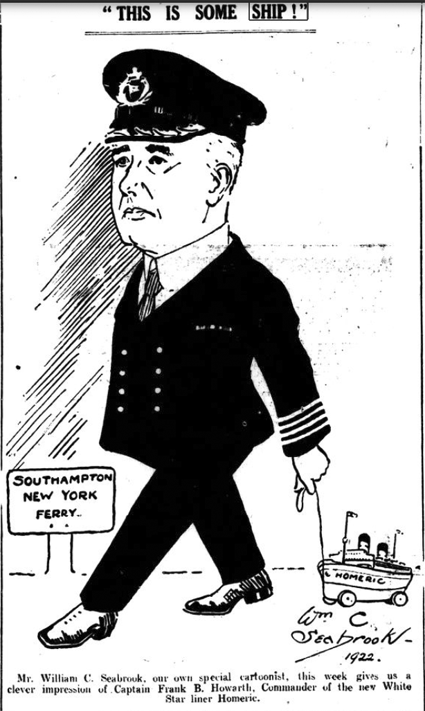
Hampshire Advertiser, 07 April 1923.
Upon retirement, Captain and Mrs. Howarth settled in Brockenhurst, not far from Southampton, in a property called “Fairhaven” on Rhinefield Road. During his retirement, Captain Howarth was far from a stranger to the sea, as he made at least half a dozen voyages as a passenger on White Star Line ships including his former commands, the Olympic and Homeric, as well as the Majestic and MV Britannic. On 21 March 1940, Captain Howarth became a widower, as his wife Clara passed away. He would not be a widower for long as three months later, on 20 June 1940, Captain Howarth himself died, at the age of 75. His funeral, conducted by the Reverend R.H. Sharpe of Winchester with assistance from the Vicar of Brockenhurst, was held nine days later. In addition to his family, at least two members of the admiralty (Rear-Admiral Edward Hilary Rymer and Rear-Admiral Edward Chisman) attended the service, where there were “many beautiful flowers.” Captain Howarth’s effects, valued at £3,625, were distributed to his son-in-law Eric Hylton Stewart. Overall, Captain Howarth’s legacy was that of “a man of exceptional charm,” with a strong reputation at sea. He was remembered as “a great favourite with travellers” and “one of the most highly esteemed masters in the White Star service.”
Books
- RMS Olympic - Titanic’s Sister (by Mark Chirnside).
Websites
- https://freepages.rootsweb.com/~cacunithistories/military/uss_zeppelin.html
- Wikipedia articles on all the ships he commanded.
- Wikipedia article on HMAT Wandilla (formerly Fort St. George).
Newspaper articles (via FindMyPast.co.uk and Newspapers.com).
- Sea Captains’ Careers. No. 12- Capt. F.B. Howarth (Commander RNR) (Hampshire Advertiser from 07-April-1923).
- Marriage Notice (Manchester Courier And Lancashire General Advertiser from 16-September-1893).
- Accident to the Afric (The Albany Advertiser from 25-August-1906).
- The Outer Harbor: White Star Line Commander’s Opinion (The Express from 05-February-1908).
- Lightning Strikes Cymric (The Montreal Gazette from 14-May-1910).
- Cymric Made Best Day’s Run - In Ocean Race With the Ivernia. - Liners May Try Another on Leaving Here Tuesday. (The Boston Globe from 26-October-1911).
- Cymric Had Hard Trip (New York Times from 22-April-1912).
- Cretic Off to Italy With Reservists - Boston Merchant to Join Aviation Corps—Italians Hold Patriotic Demonstration as the Liner Leaves Dock. (The Boston Globe from 05-June-1915).
- Man on Cretic Reports Seeing Raider Moewe (Morning Sentinel from 12-February-1916).
- Ships Given Flag Of Panama as Test, Asserts Harriman - Will Be Restored to Registry of U.S. if Dry Ruling Is Changed or if Lines of Government Show Profit (New York Tribune from 08-December-1922).
- Marriage of Miss Madeline Howarth (Hampshire Independent from 23-March-1923).
- Olympic Hits Liner in River; 3 Injured (New York Times from 23-March-1924).
- Births Marriages & Deaths (Chester Chronicle, and Cheshire and North Wales General Advertiser from 28-June-1924).
- Olympic’s Captain Retires (The Scotsman from 5-January-1925).
- Olympic’s Commander (Liverpool Journal of Commerce from 6-January-1925).
- Fifty Years at Sea. Death of Captain F.B. Howarth (Liverpool Journal of Commerce from 29-June-1940).
- Death of Capt. Haworth. Served at Sea for Half a Century (New Milton Advertiser from 29-June-1940).
- Silver Wedding (Cheshire Observer from 30-August-1947).
Other Sources
- 1871 United Kingdom Census (via FindMyPast.co.uk).
- 1881 United Kingdom Census (via FindMyPast.co.uk).
- 1901 United Kingdom Census (via FindMyPast.co.uk).
- 1939 United Kingdom Register (via FindMyPast.co.uk).
- White Star Line record of company service (via FindMyPast.co.uk).
- RNR Service Records (ADM-240), The National Archives.
- Jean Legg - Daughter of Titanic Survivor & Author | "Titanic's Last Hand: Sidney Daniels" (Titanic Book Club on YouTube).
- Immigration Records (via FamilySearch.org).
- England & Wales Government Probate Death Index (via FindMyPast.co.uk)
If this website has been of some help, please consider supporting it with a coffee
to ensure it can continue. It can be anonymous. Anything helps!: