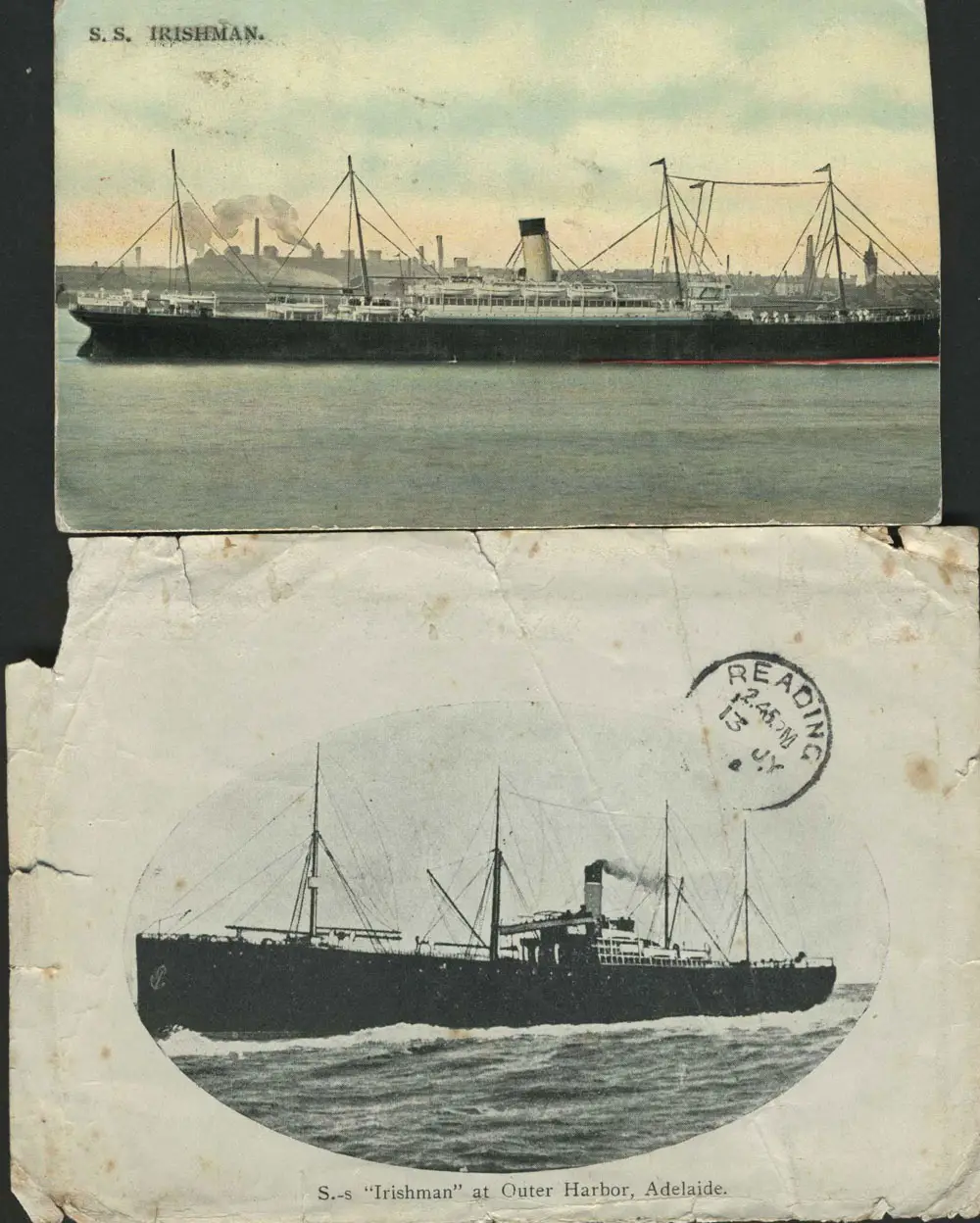
Boxhall was reported to be aboard the Irishman in Adelaide, Australia, November 1912. (Click image to enlarge)
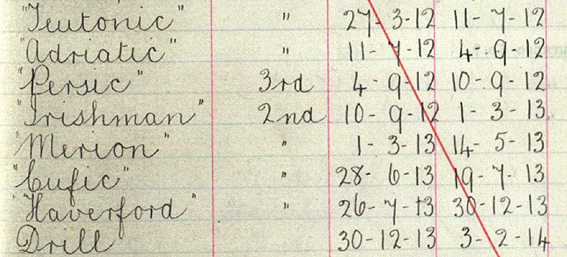
Following the Titanic sinking and inquiries (during which his White Star Line record unsually lists him as aboard the Teutonic 27.3.12 - 11.7.12), Boxhall briefly served as Fourth Officer on White Star's Adriatic, the ship that had brought him back to England from the United States after the Senate Inquiry (from 11.7.12 - 4.9.12) in capacity as Fourth Officer. We certainly know he was aboard the Adriatic in July 1912 when he wrote his complaint to the Board of Trade.
Boxhall's White Star Line record between the Titanic and serving in the Navy during the First World War.
He briefly serves aboard the Persic as Third Officer (4.9.12 - 10.9.12), until promoted to Second Officer on the Irishman (10.9.12 - 1.3.13). According to the Sydney Evening News of Thursday 14th November 1912, Boxhall visited Australia in November 1912 aboard the steamer Irishman which travelled from London to Port Adelaide. This has been verfied by an announcement in the Nautical Magazine that "Lieut. J G. Boxhall, R.N.R. has been appointed second officer of the White Star liner Irishman, employed in the Australian trade." The Sydney Evening News article states:
The population of New South Wales was to-day increased by the arrival of the
steamer Irishman, from London, via Port Adelaide, with 639 new-chums on
board. But they will not be allowed to land until to-morrow, owing to
certain quarantine regulations...
There is another member of the Titanic crew on board the Irishman, in the
person of Mr. Boxall [sic]. He was fourth officer of the big liner, and burned the
blue lights, which the Californian saw, but did not acknowledge. (Evening News (Sydney) Thursday 14th November 1912)
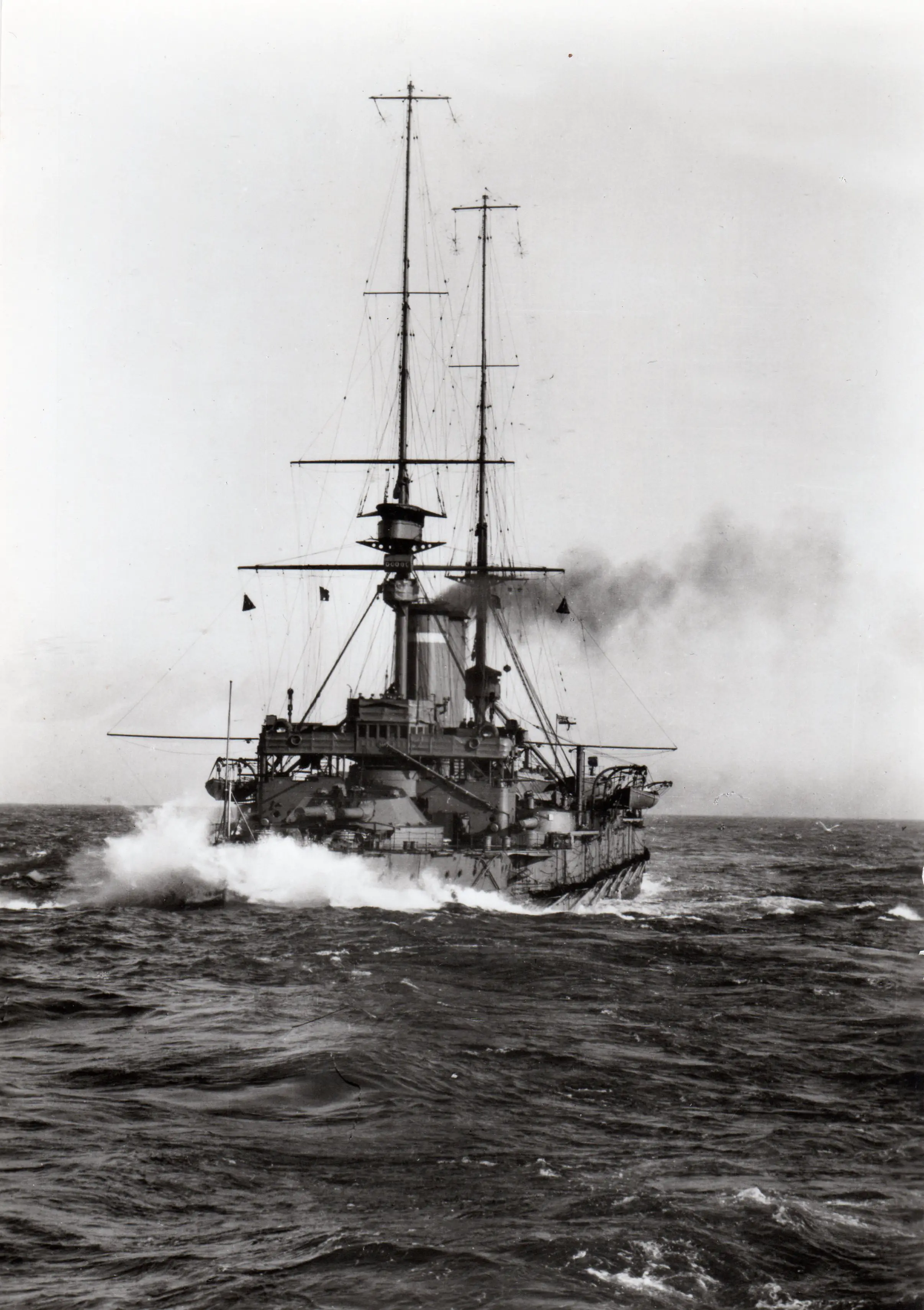
Boxhall was commissioned to serve for one year aboard the battleship HMS Commonwealth during World War One. (Click image to enlarge)
In the year before the First World War, Boxhall worked as Second Officer aboard the Merion (1.3.13 - 14.5.13), Runic (28.6.13 - 19.7.13) and the Haverford (26.7.13 - 30.12.13) before being placed on "Drill" (30.12.13 - 3.2.14) at HMS Vivid (the Royal Navy designation for the barracks at Devonport in England and for other nominal bases in Cornwall, Ireland and Wales). The White Star lists Boxhall as employed by the Navy from the 3rd of February 1912 until the 29th of April 1919. He was promoted to lieutenant in the RNR on 27 May 1915. During the First World War, he was commissioned to serve for one year aboard the battleship HMS Commonwealth before being dispatched to Gibraltar, where he commanded a torpedo boat.
According to his RNR training notes, there were differeing opinions of him during the war years. For example, in 1916 (while likely aboard HMS Defiance) he was described as "average...take charge well. A good seaman & navigation" while the following year he was brutally described as having a "painstaking lack of physical stamina" (The National Archives' reference ADM 240/82/146). When he was demoblised on the 21st February 1919 he was described as "Above av[erage]: Zealous, hardworking, conscientious, good initiative." (The National Archives' reference ADM 240/56/26)
Marriage
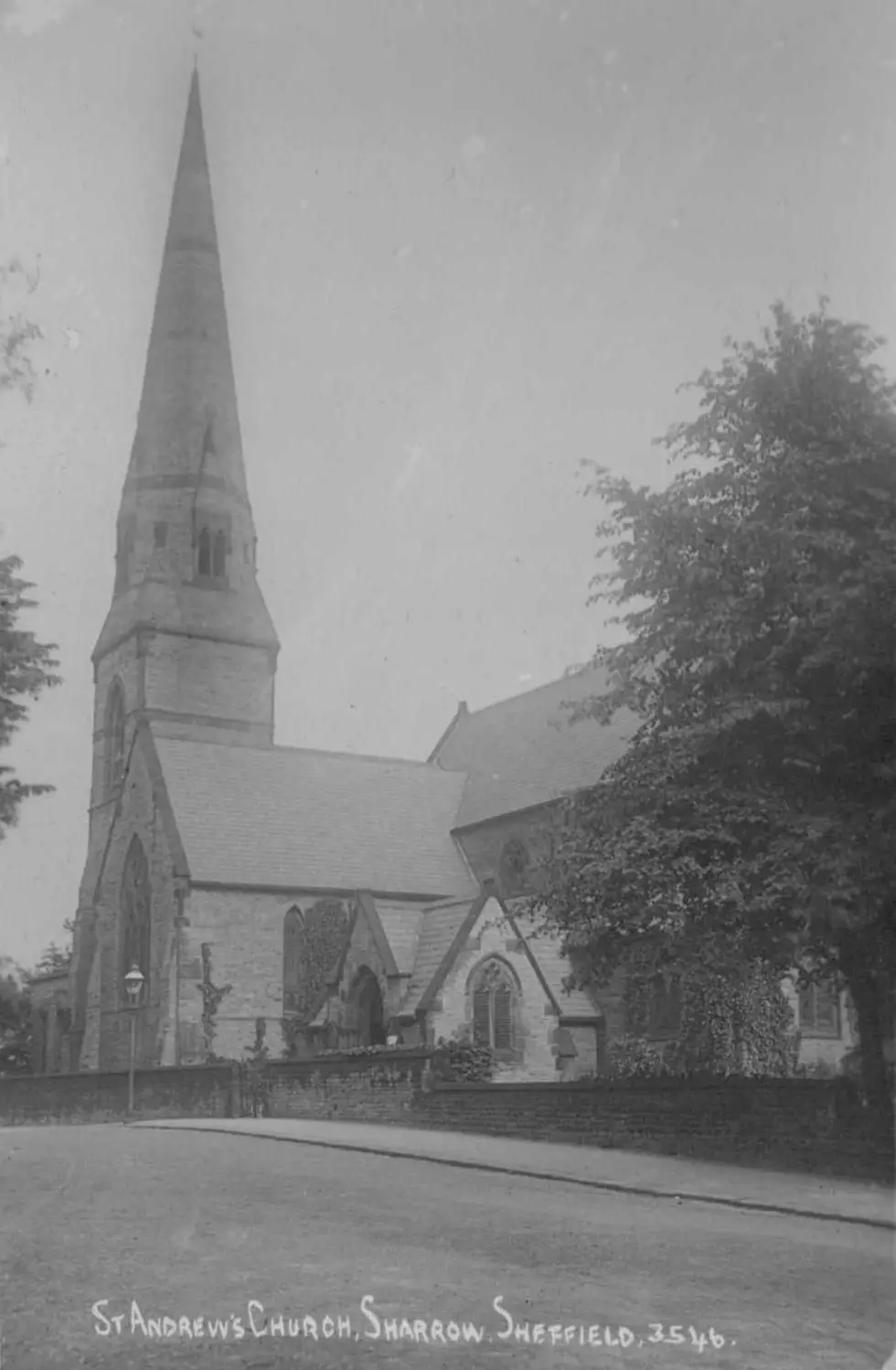
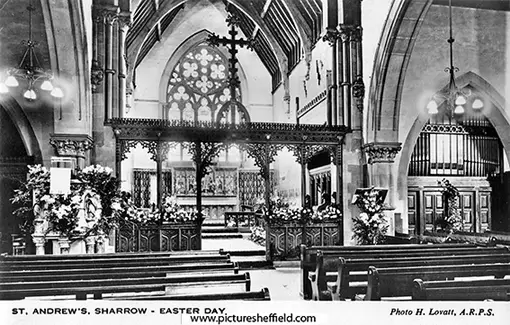
St Andrew's Church in Sharrow, Sheffield, where Joseph Boxhall married Marjory Beddells. (Click to enlarge)
After his return from the war, Boxhall married Marjory Beddells, daughter of a Yorkshire industrialist, on 25 March 1919 in St Andrew's Church near her home in Sharrow, Sheffield. Majory was born on the 24th June 1882 in Sheffield, Yorkshire (although the 1939 Register lists her birth year as 1883). The marriage was apparently a happy one, although the couple were childless. She later died Sep 1972 in Bournemouth, Hampshire, England.
Titanic author and researcher Inger Sheil provided an insight into the marriage and a previous engagement:
I don't know if Marjory and Joseph knew each other at the time of the Titanic disaster, or indeed when they first met, but if they were acquainted in 1912 they were not romantically involved. Joseph, by the beginning of WWI, was engaged to a woman from Australia. Whether he knew her at the time he joined the Titanic is another question - her son believed they met after the Titanic and before the war, but there is a chance that he had known her as early as 1911 when he was on the Australian run. Their engagement terminated during WWI, and it was after this period that he married Marjory.
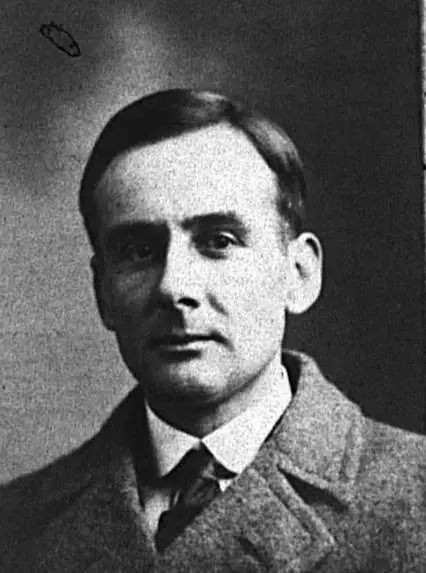
Boxhall in a photograph dated 1919. (Click image to enlarge)
Marjory was not - as that very overused phrase goes - 'conventionally beautiful'. One of the family observed to me that she found it quite unusual, given the beautiful socialites who had pursued him as a ship's officer, that Joseph opted to marry someone who, if not unattractive, was quite plain...
She was a very active, energetic woman, with a very strong personality. Towards the end of her life she did pick up a few eccentricities and could sometimes become easily offended, but she was - like her husband - a very generous person. I don't know why they decided not to have children, or even if it was a conscious decision. They seem to have liked children, and to have been very fond of their dogs (child substitutes?). Her correspondence after the death of her husband, describing his last years, is very moving...
Joseph and his ex-fiance did remain in touch for many, many years, and he even visited her at least once. Given the circumstances under which the romantic relationship terminated, it's remarkable that they continued to write in later years, and rather poignant... Suffice it to say, it was terminated abruptly and in such a way that poor Boxhall would be justified in feeling aggrieved (and this is the version from the family of the woman involved). It's a rather tragic little tale...but it does show Boxhall as rather a class act. (Inger Sheil, 2004, Encyclopedia Titanica)
Interior of St Andrews Church where Joseph and Marjory Boxhall were married.
Boxhall returned to the merchant service rejoining the White Star Line in April 1919, two months after his marriage. He is listed as joining the Cedric as Second Officer om the 29th of April 1919, until the 6th January 1920. For the next three years he worked aboard a series of White Star ships and other International Mercantile Marine ships, sailing to the United States, Canada and Australia. These included the Medic(6.5.20 - 20.12.20) and Runic(on "Standby" 19.1.21 - 26.2.21), as well as the Celtic(3.9.21 - 13.11.21), Tropic (Standby 16.11.21 - 25.11.21), Persic(11.1.22 - 22.2.22), Megantic (29.6.23 - 19.8.23) and Arabic (24.8.23 - 10.10.23).
According to Ellis Island immigration records, Boxhall visited New York on three occasions:
Sep 15 1919 SS Cedric - Second officer, 5ft 8 inch, 154 lbs Oct 27 1919 SS Cedric - Second officer, 5ft 8 inch, 154 lbs Jan 29 1923 SS Regina - Second officer, age 38, 5ft 7 inch, 143 lbs
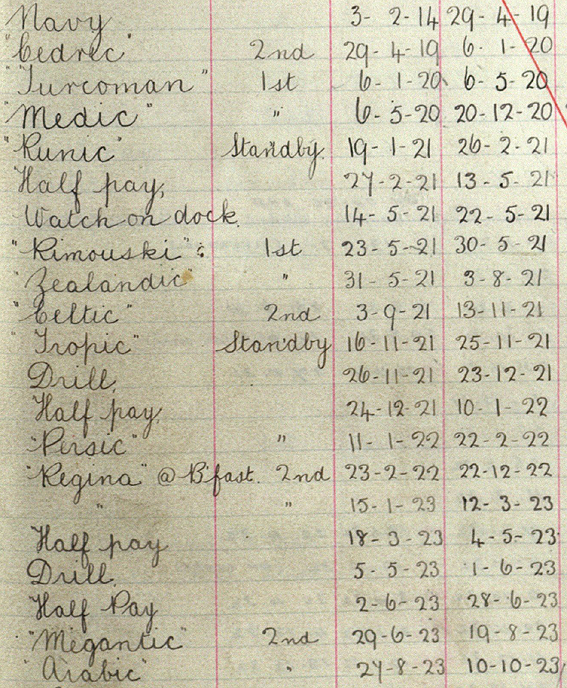
Boxhall's White Star Line record between finishing at the Navy and his resignation in 1923.
There were however signs of a problem arising. Aboard the Turcoman, Medic and the Rimouski he achieved the rank of First Officer but while on the Turcoman it was for four months (6.1.20 - 6.5.20) and on the Medic 7 months (6.5.20 - 20.12.20), on the third occasion, aboard the Rimouski. it was only for a matter of days - from 23.5.21 - 30.5.21 before he was back once again as Second Officer, while on the Zealandic he was First Officer between 31.5.21 - 3.8.21 before returning to Second Officer duties.
The reality is that aboard several of these ships Boxhall was actually on "standby" (Runic, Tropic) and there was also a disturbing reoccurance of the term "Half-pay" (27.2.21 - 13.5.21, 24.12.21 - 10.1.22, 18.3.23 - 4.5.23 and 2.6.23 - 28.6.23). "Half-pay" was a term used in the British Army and Royal Navy of the 18th, 19th and early 20th centuries to refer to the pay or allowance an officer received when in retirement or not in actual service. He was not the only officer - Harold Lowe (Titanic's Fifth Officer) also experienced the same between 1921 and 1922, as well as also being on standby (check his records here). Work was simply becoming increasingly hard to find. Boxhall was also occassionally on drill (26.11.21 - 23.12.21, 5.5.23 - 1.6.23) and even spent a spell in Belfast aboard the Regina (23.2.22 - 22.12.22, 15.1.23 - 12.3.23).
Boxhall's White Star Line record reveals that he resigned from the line for a year between the 27th of October 1923 and 29th November 1924.
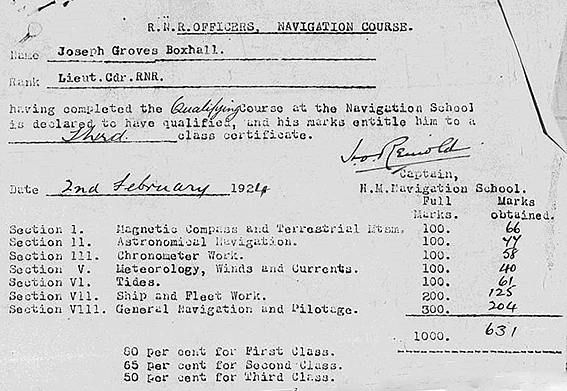
On 27 May 1923, he had been promoted to lieutenant-commander in the RNR. But something was not right. Perhaps the lack of consisten work is what caused him to resign on the 27th of October 1923, although it lasted just over a year, as he was reinstated on the 29th November 1924. Earlier that year - on the second of February 1924, he had gone back to school, attending the R.N.R. Officers Navigation Course which he completed with a disappointing "thid class certificate" having obtained 631 marks out of 1000. His weakness seemed to be "Metereology, Winds and Currents" in which he got the lostest marks and resulted in a pass, but with the lowest tier.
Boxhall took a R.N.R. Officers Navigation Course in February 1924 for he which he obtained a disappointing "third class certificate". (The National Archives/reference ADM 240/56/26)
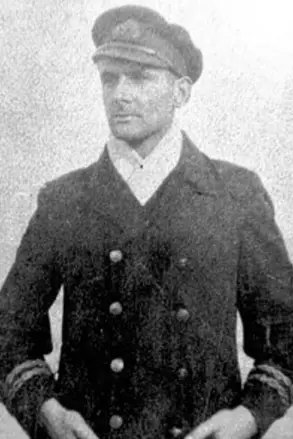
Boxhall during his torpedo boat service, with two bands indicating he is a lieutenant. (Boxhall family/Inger Sheil)
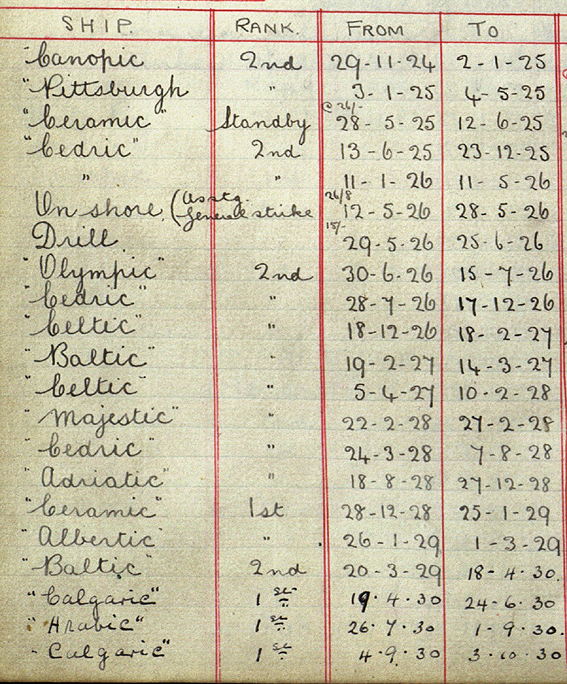
His first ship on returning to the line is the Canopic, with the rank of Second Officer once again (29.11.24 - 2.1.25). In fact, he remains in that rank for the next four years while serviing aboard the Pittsburgh(3.1.25 - 4.5.25), Cermamic(standby - 28.5.25 - 12.6.25) and Cedric(13.6.25 - 23.12.25, 1.1.26 - 11.5.26)
After a spell onshore due to a general strike (12.5.26 - 28.5.26 15) he signed on as Second Officer on board the Titanic's sister ship -the RMS Olympic on 30 June 1926.
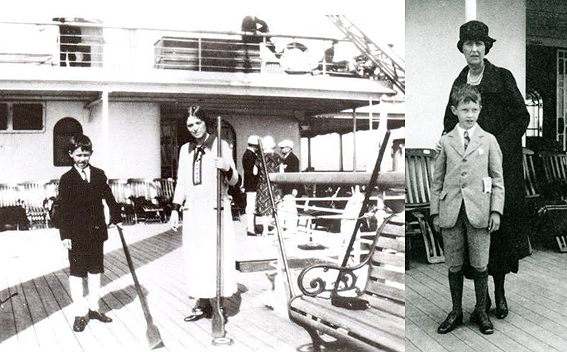
In an interesting twist of fate, it seems that the author of Titanic classic "A Night to Remember," Walter Lord, was indeed aboard the Olympic at the same time as Boxhall was listed as Second Officer: 30.6.1926 - 15.7.1926. The date is confirmed in both the White Star Line record and Boxhal's RNR records which state he served aboard the Olympic as "2nd mate 30.6.26 - 15.7.26" Additionally, the ship's manifest for the Olympic voyage dated on its arrival in New York on the 7th of July 1926 that lists 42 year old Boxhall as the "2nd Mate." Walter Lord was aboard, as an eight-year-old, on the 9 July 1926 return voyage from New York, as he later wrote: "It had been decreed that I must go directly to bed, and so I was never able to join the crowds that lined the rails as the great White Star liner eased from her New York pier on July 9, 1926." Interestingly, Boxhall would later be an advisor to the film that was made based on Lord's book "A Night to Remember." Did they ever realise their paths had crossed and/or even met each other? You can read Lord's memories of his voyage here: https://titanichistoricalsociety.org/memories-of-the-olympic/
Author Walter Lord on board the Olympic at the same time as Boxhall was Second Officer, in July 1926.(Gilman School Archives, Walter Lord Collection)
After only one voyage with the Olympic, Boxhall was back on the his other regular ships - Cedric(28.7.26 - 17.12.26, 24.3.28 - 7.8.28), Celtic (18.12.26 - 18.2.27, 5.4.27 - 10.2.28), Baltic (19.2.27 - 14.3.27, 20.3.29 - 18.4.30) and Majestic(22.2.28 - 27.2.28), until 1928 when he was aboard the Adriatic for the first time since 1912 (18.8.28 - 27.12.28). Change was in the air when he briefly was made First Officer aboard the Ceramic (28.12.28 - 25.1.29) and Albentic(26.1.29 - 1.3.29), until 1930 signaled his time to finally reach First Officer on a consistent basis - aboard the Balgaric(19.4.30 - 24.6.30), Arabic(26.7.30 - 1.9.30), Culgaric(4.9.30 - 3.10.30) and Laurentic(6.12-30 - 12.12.30).
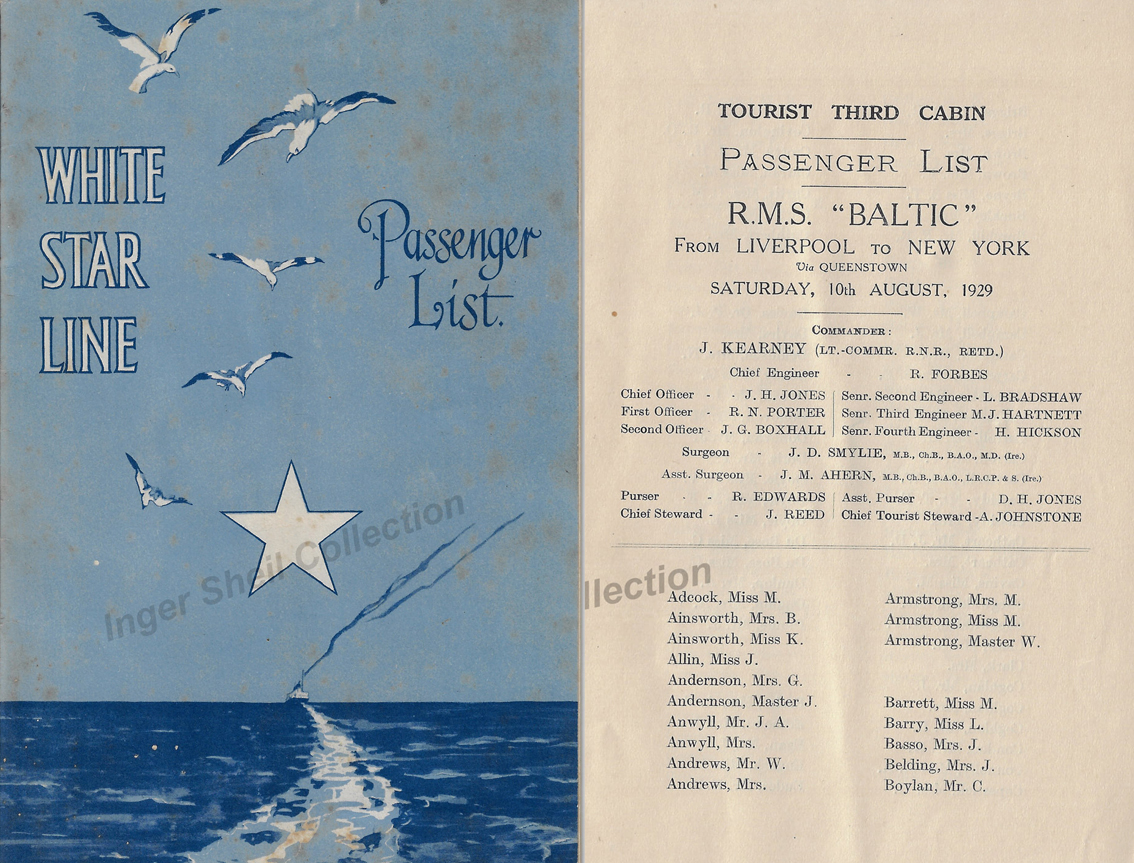
A Tourist Third Cabin Passenger List for the RMS Baltic dated the 10 August, 1929, for the Liverpool to New York crossing, lists Boxhall has the Second Officer. Courtesy of Inger Sheil (Click image to enlarge)
During this time, His father, Joseph Boxhall senior, a captain of the Wilson Line, died on the 29th of May 1928 aged 70. Also, in one notable anomaly with the above list of ships in his White Star Line record is a US Department of Labor document dated 28 June 1930 for the Baltic which lists a "J Groves Boxhall, 46, British" as a "Seamen signed on at this post" and consequently returning to Liverpool arriving on the 9th of July 1930. As he was not listed in the capacity of an officer, it seems he had not returned on the previous voyage aboard the Balgaric, where he was listed as First Officer, 19.4.30 - 24.6.30. This anomaly may be connected with what happened next.
Having finally made the rank of First Officer, he spoiled his opportunities while aboard the Arabic in the Eastern Mediterranean (26.7.30 - 1.9.30)) due to "insolence to General Harington & Staff" which resulted in him have to forfeit "13 months, 2 days of seniority" although this was later altered to "6 mths loss of seniority, Feb 1930." What had Boxhall done to be accused of "insolence" involving a general? If this was General Charles Harington (1872 - 1940), then Harington had just been made aide-de-camp general to King George V. a few months earlier in April 1930.
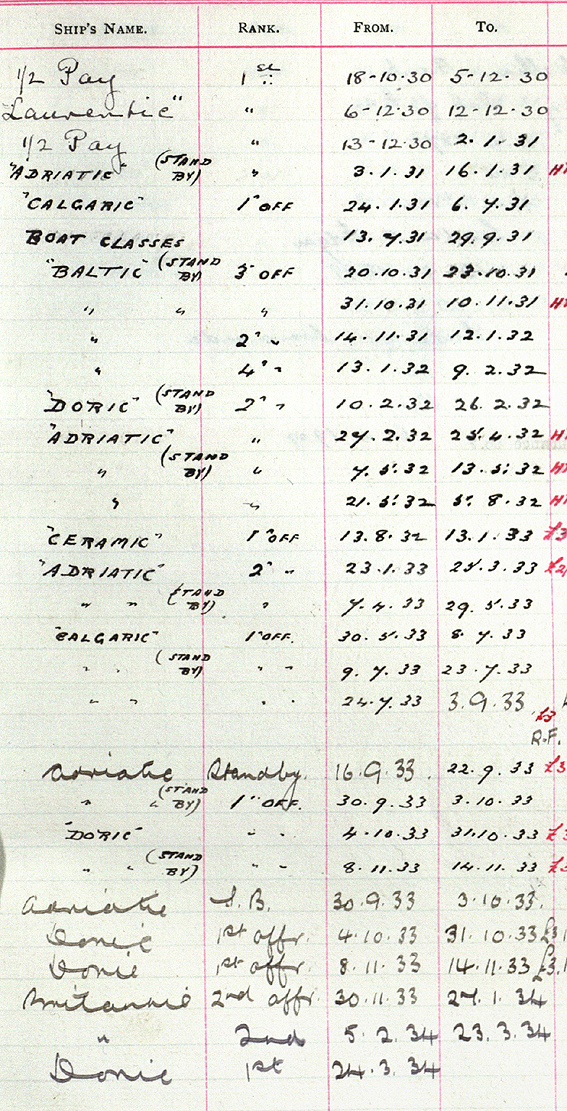
Boxhall's White Star Line record between 1924 - 1930.
But the 1930s in the wake of the stock market crash of 1929 brought financial difficulties once again and he was listed for "half pay" twice in 1930 (18.10.30 - 5.12.30 and 31.12.30 - 2.1.31) inbetween a six day spell aboard the Laurentic in December. From 1931 through to 1934 he worked aboard familiar White Star ships the Adriatic, Calgaric, Baltic, Doric, Ceramic and Britannic but with signs that nothing was certain at a time of economic uncertainty. In fact aboard many of those ships he is listed as "stand by" (Adriatic, Doric, Calgaric and Adriatic) and aboard the Baltic he was a "stand by 3 off" i.e. a standby junior Third Officer, as well as later as low as Fourth Officer. He may well have been looking at other options as a note in his White Star record about the holiday he took in September 1933 "To take command of yacht tmp. Did not materialise" indicates he had explored another possible options.
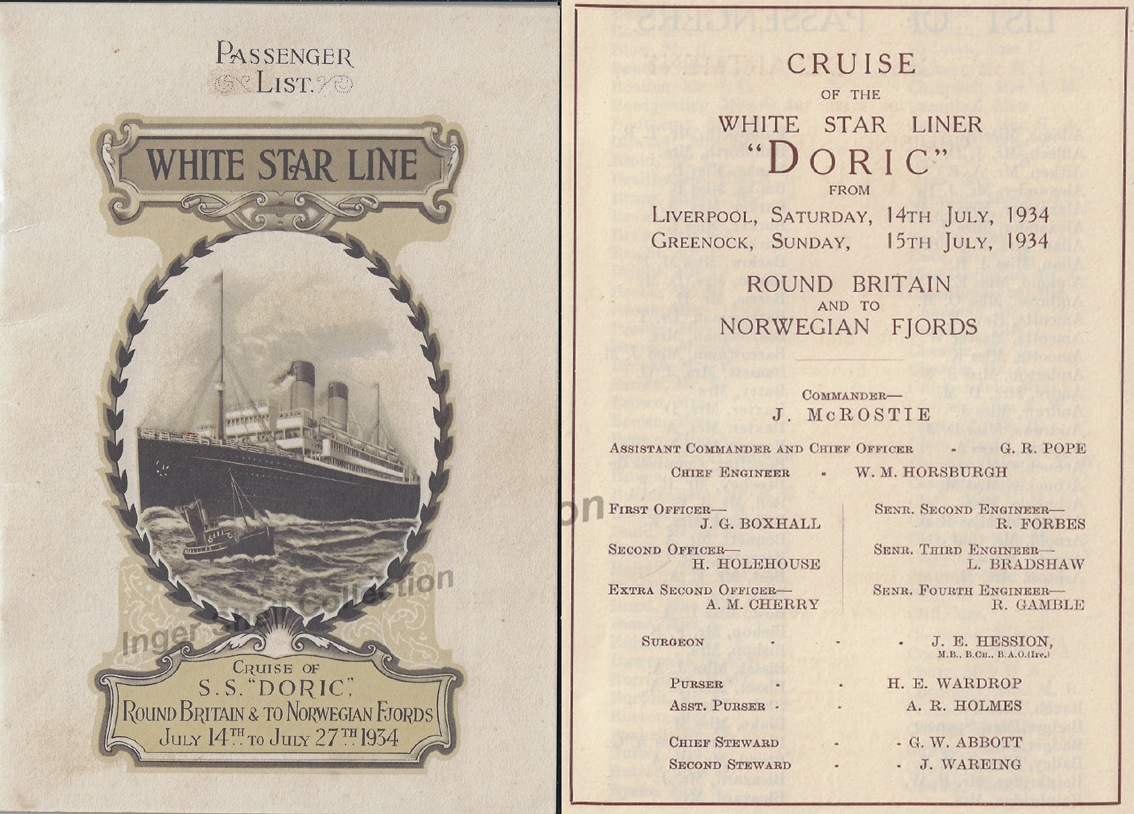
His last posting as a White Star officer was aboard the Doric as First Officer (24.3.1934 - 1935), the highest rank he would achieve for the company. One of these voyages dated 14th July to the 27th July 1934 departed from Livepool and went "round Britian & to Norwegian Fjords" according to a passenger list. Also of note is that Harold Holehouse was serving as Second Officer on this voyage. Inger SHEIL first identified Holehouse as the man misidentified as Harold Lowe in the photos of Olympic's maiden voyage (often misrepresented as the Titanic's officers) using the Olympic's crew lists and the CR10 files at the PRO (see article on this here).
Boxhall's White Star Line record from 1930 until his last White Star Line posting as a First Officer aboard the Doric in 1934.
Passenger List for the Doric's July 1934 cruise around Britain and the Norwegian Fjords, with First Officer J G Boxhall on the crew's roster. Courtesy of Inger Sheil (Click image to enlarge)
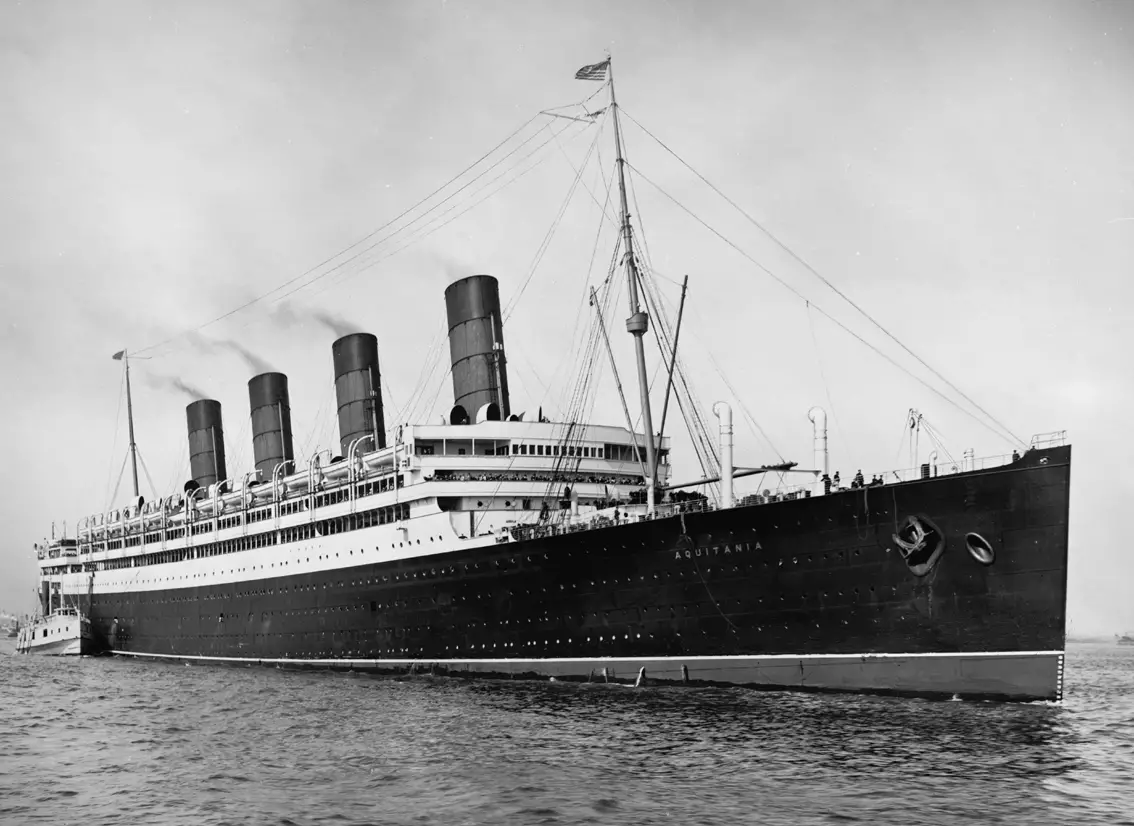
With the White Star Line merging with former rival in Cunard in 1933, Boxhall's White Star service record ends there. He served in a senior capacity as first and later chief officer of the RMS Aquitania, although he was never made a captain in the merchant marine. (The White Star line never promoted any of the surviving Titanic officers to command rank, but this is not necessarily due to the sinking - post-war jobs were simply hard to come by.)
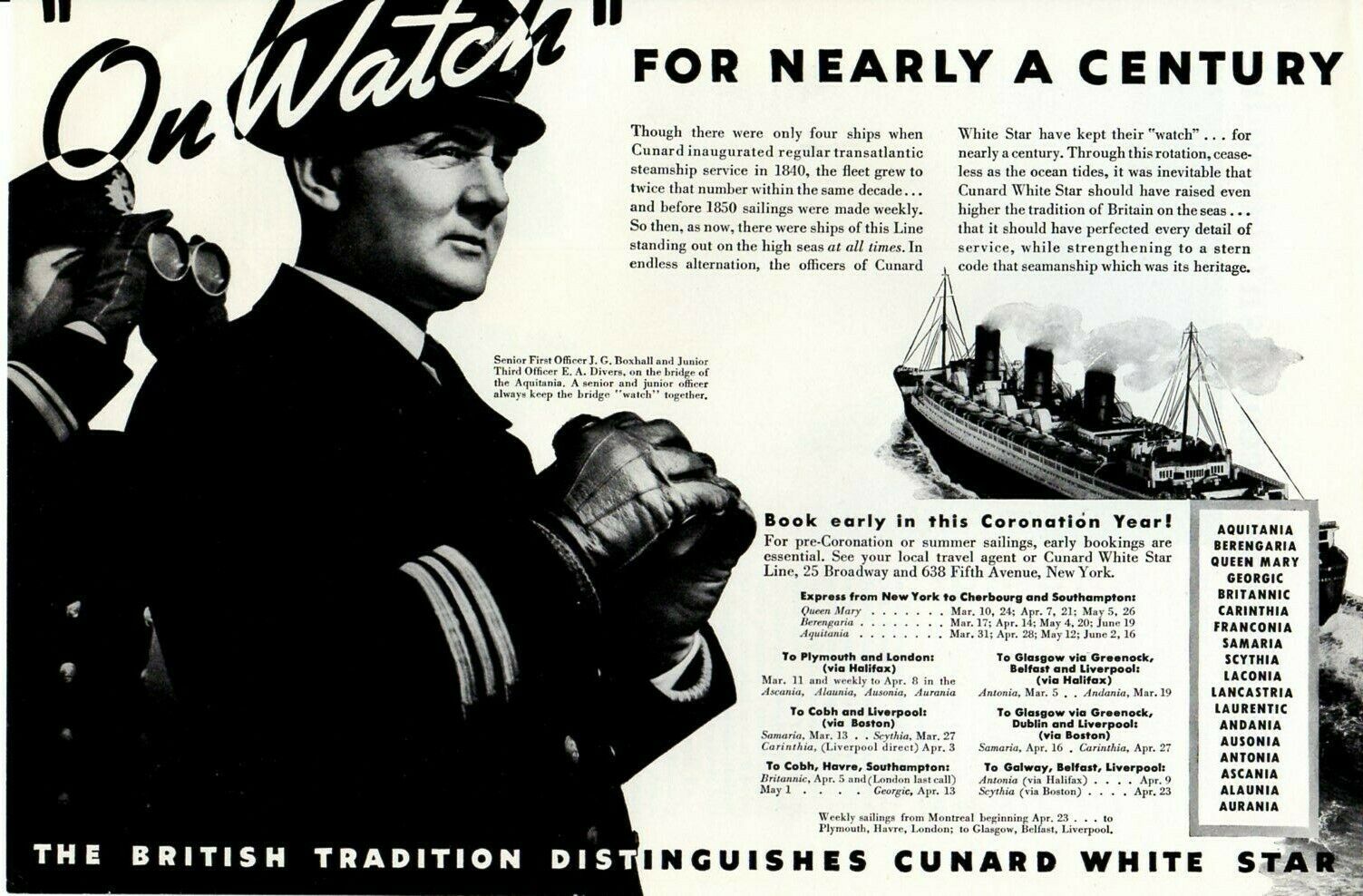
Boxhall appeared prominently in a large Cunard "On Watch" advertisement in 1937 that appeared in "Life" and "National Geographic" magazines where he is described as the "Senior First officer" although he is wearing three stripes which would previously in the White Star Line made him technically Chief Officer. He is shown aboard the bridge of the Aquitania, holding a pair of binoculars. Interestingly, this advertisement appeared 25 years after the sinking of the Titanic so it is curious that they chose Boxhall to appear with the phrase "On Watch" considering that he was 'on watch' during Titanic's collision with an iceberg. It is likely coincidental that he was used. Another interesting detail about this version is the caption, which reads that a senior and junior officer "always keep the bridge watch together" is that Boxhall was, by his own admission, having a cup of tea in his cabin when his senior officer, Murdoch, was "on watch" and had to take evasive manoeuvres on the spotting of an iceberg ahead. This advertisment was also published in the March 1937 issue of "Review of Reviews" magazine, which was founded by W.T. Stead who was lost on the Titanic (information courtesy of Gregg Jasper).
Cunard "On Watch" advertisement that appeared in 1937 - he is now a "senior officer." Credit: Dan E. Parkes collection. (Click image to enlarge)
The S.S. Aquitania aboard which Boxhall served as "senior first officer." (Click image to enlarge)
Boxhall's RNR records can help us piece together the last ships he served aboard, which are the Berengaria (as a "junior 1st officer, 15.1.35 - 1.2.35), the Aquitania (1st officer 21.10.36 - 17.11.36), the Franconia (1st officer 24.12.36 - 10.6.37) and the Alaunia (senior 1st off 23.9.37 - 17.10.37). He is also listed seperately in a crew manifest for the Franconia as "senr 1st" between Liverpool and Boston dated 20 June 1937.
Then in 1938 he finally made the new rank of Chief Officer aboard the Ausonia (29.4.38, 1.1.39, 29.4.39) although the rank of Chief Officer is dated 27.4.39 - only a few days before he was discharged from the ship. This is confirmed by a separate crew manifest that places Boxhall as "Sen, 1st" on a voyage of the Ausonia that arrived in New York on 15 March 1939. Later in the year, during the 1939 Register, which served as a census substitute for England and Wales prior to the war and taken on September 29, 1939, Boxhall is listed as living at Sea Road "Beverly", Lymington, Hampshire, along with his wife Majory but more importantly his occupation is listed as "Chief Officer Mercantile Marine Commander R.N.R."
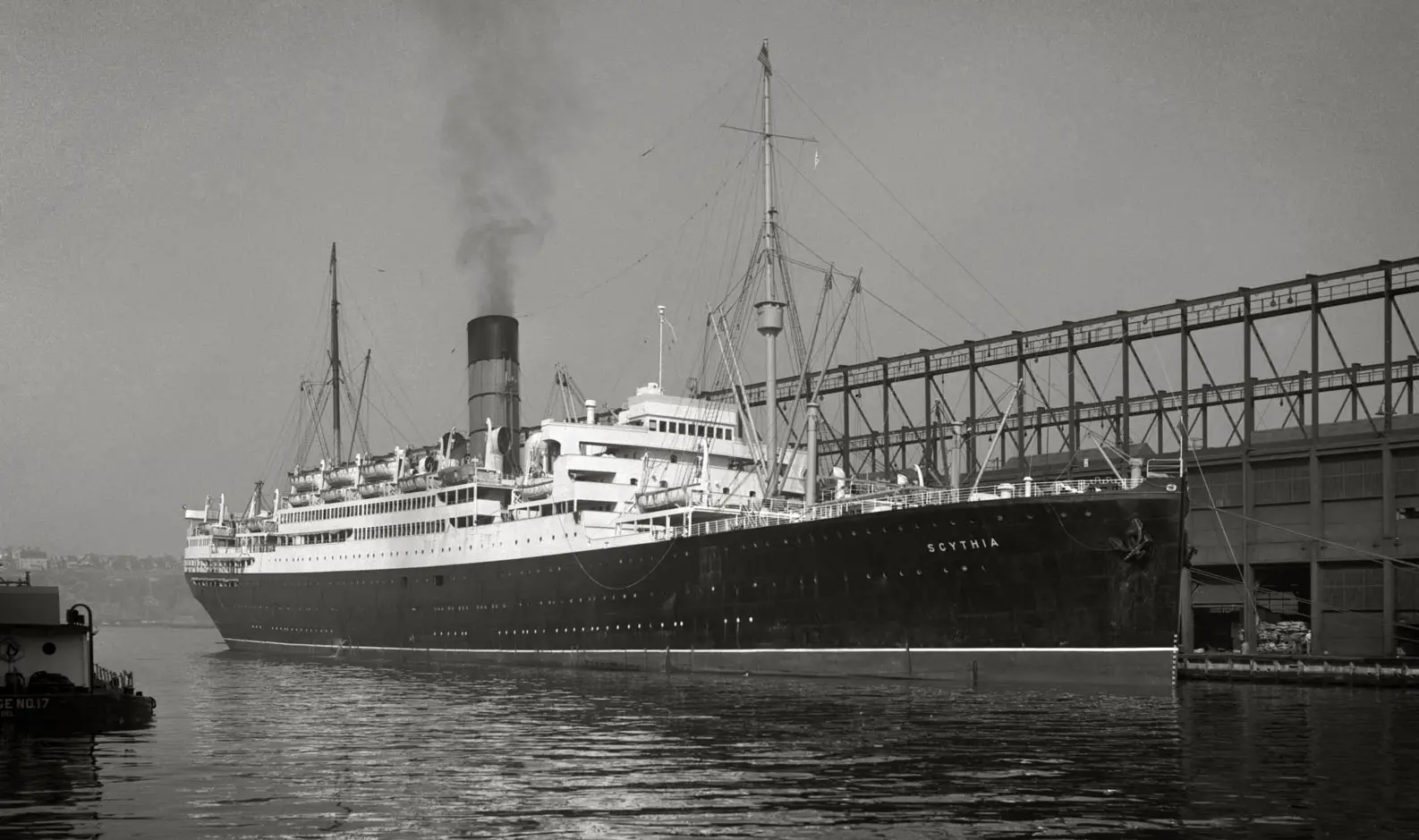
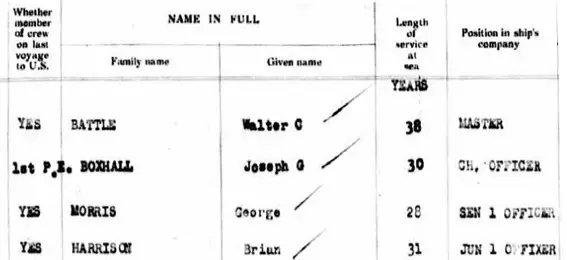
On the 3rd of January 1940 he is then listed in his RNR records as "Employed as Chf Offr by Cunard White Star - unemployed at present owing to continuous ill health, Cunard WS retired him as unfit". There is a sign on document for the Scythia that confirms he was indeed listed as Chief Officer - a rank finally achieved after 40 years of service.
In 1940 Boxhall was listed as the Chief officer aboard the Scythia, one of the last - if not the last - ship he worked aboard,. as there are no further records of any other ships. So it can be assumed that in that same year he retired, after 41 years at sea. By 1944 he is described as working as a clerk in the Lymington Borough council before his final listing dated 20.5.44 - 23.5.44 "Employed as Marine Superdt: by the U.S. Army"
One of Boxhall's last ships before he retired, the Scythia, which he served aboard in the capacity of chief officer. (Click image to enlarge)
A sign on document showing Boxhall listed as chief officer in 1940 after "30" years" of service.
His RNR records make a note that he was placed on the "Retired List (Age)," with the rank of Commander, a title he would subsequently use, despite mever having achieved captaincy during his merchant career. An October 1948 RNR form confirms that his rank was officially "Commander RETD" and noting his address was then at "Woodcroft" St Martins Hill Lane, Burton, Christchurch (Telephone Christchurch 1321).